The DQA tool determines proper gradient polarity and proper gradient wiring by scanning a series of axial and coronal images of the DQA III phantom.
Prerequisites
Personnel requirements
Required persons
Preliminary requirements
Procedure
Finalization
1
-
30 minutes (varies)
10 minutes
Tools and test equipment
Item
Quantity
Part number
Manufacturer
DQA III Phantom
1
2321556
-
Table 1. Tools and test equipment
Item
Quantity
Effectivity
Part number
Manufacturer
DQA III Phantom
1
-
2321556
-
Required conditions
This procedure requires an accurate landmark. Make sure the laser light alignment is complete. Troubleshoot any problems you find while doing this calibration.
Condition
Reference
Effectivity
Laser light alignment completed.
-
-
Safety
Before working in any GE Healthcare MR suite or performing any GE Healthcare service procedure, you must:
Have read and understood all hazard conditions and safety requirements in the latest revision of the GE Healthcare MR Service Safety Manual (5452735).
Have successfully completed all relevant GE Healthcare Environmental Health and Safety (EHS) courses (or for non-GE employees, equivalent workplace training courses).
Comply with all site-specific training and workplace safety requirements.
If you have any safety concerns at any time, do not begin work or immediately stop work and move to a safe location. Immediately contact your supervisor or site safety officer for instructions on how to proceed.
About this task
The DQA tool determines proper gradient polarity (positive to positive and negative to negative) and proper gradient wiring (X amp drives X coil, Y amp drives Y coil, Z amp drives Z coil) by scanning a series of axial and coronal images of the DQA III phantom. The tool also verifies that the proper phantom is being used. After proper gradient orientation is confirmed, the tool adjusts for Z isocenter and gradient calibration. If Z iso adjustments or gradient calibration adjustments are required, the DQA tool performs the appropriate iterations to complete. Therefore, the DQA tool time to complete may vary.
Procedure
Verify that Checking and aligning the laser light was completed. Pay close attention when positioning the alignment light on the phantom, because this procedure requires an accurate landmark.

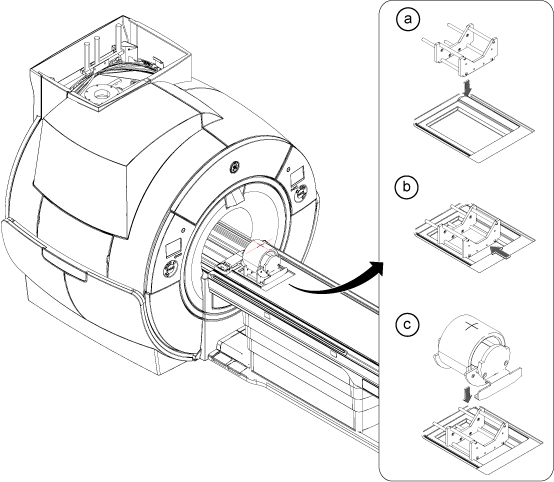 Note: This image is a representative example. Actual systems may vary.
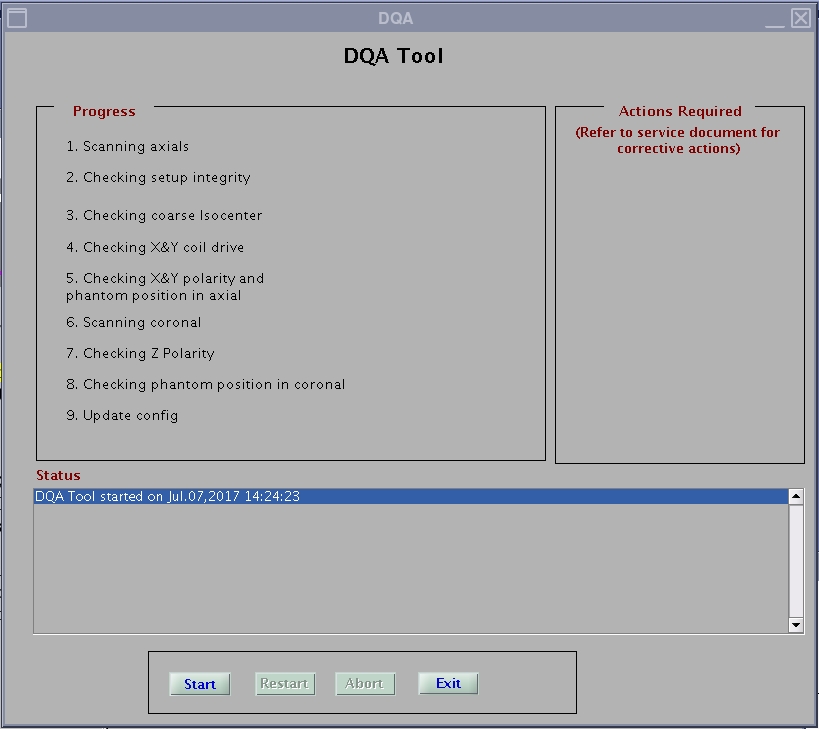 To stop the DQA tool without restarting it, click Abort at any time.
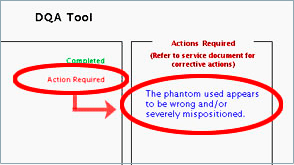 Note: After resolving the issues in the Actions Required section, click Restart to restart the DQA tool.
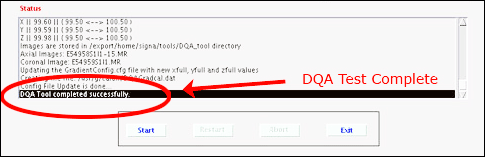 Note: The finalization steps are included at the end of this procedure.