Before working in any GE Healthcare MR suite or performing any GE Healthcare service procedure, you must:
Have read and understood all hazard conditions and safety requirements in the latest revision of the GE Healthcare MR Service Safety Manual (5452735).
Have successfully completed all relevant GE Healthcare Environmental Health and Safety (EHS) courses (or for non-GE employees, equivalent workplace training courses).
Comply with all site-specific training and workplace safety requirements.
If you have any safety concerns at any time, do not begin work or immediately stop work and move to a safe location. Immediately contact your supervisor or site safety officer for instructions on how to proceed.
Warning
Potential retinal burn
Invisible laser radiation may be emitted from disconnected fibers or connectors causing a retinal burn.
Avoid staring into beams or viewing directly with any optical instruments.
Reminders:
Always turn off laser sources before you inspect fiber connections.
Always keep a protective cap on unplugged fiber ferrules.
Notice
Potential component damage
Electrostatic discharge (ESD) can cause permanent damage to electronic components.
Observe the following ESD precautions:
Work on a static-free mat.
Wear a static strap to make sure that any accumulated electrostatic charge is discharged from your body to the ground.
Create a common ground for the equipment being worked on by connecting the static-free mat, static strap, and peripheral units to that piece of equipment.
Notice
Potential component damage
The SFP optical transceiver is very sensitive to electrostatic discharge (ESD), dust, and body oil. When working with the SFP optical transceiver:
Always use ESD protection when handling the SFP optical transceiver to prevent early failure.
Never touch the SFP optical transceiver without being properly grounded.
Never touch the end face of the optical connectors.
Never re-use lens tissue or cleaning swabs.
Always keep a protective cap on unplugged fiber connections.
Always inspect the connection before cleaning.
The SFP must be shipped in antistatic packaging. Discard any SFP shipped or stored without proper ESD protection.
Some SFPs are shipped in insulated envelopes which can produce excessive contaminates. Do not open these containers in the area where you will be working with the SFP. Remove the antistatic bag containing the SFP and move to a clean area to work.
Notice
Possible component damage
The fiber optic cable can easily be damaged by improper handling. Bending, twisting, kinking, or squeezing the cable may cause internal breaks along the fiber, resulting in poor performance or instability.
When working with fiber optic cable:
Avoid bending the fiber optic cable, or allowing the cable to hang, causing a macrobend in the cable.
Do not allow the end of the fiber optic cable to make contact with any surface, including direct contact with fingers. The optical coating on the lens is easily chipped and scratched.
Never run fiber optic cable without the protective caps in place.
Avoid pulling on the cable end, because this can damage the fiber optic.
About this task
Fiber optic cables can easily be damaged if they are improperly handled during installation or during the replacement of connectors. Proper cleaning is required because microscopic contamination in the fiber connection will cause intermittent signals, due to degraded signal power, resulting in failure of the component or failure of the whole system.
This procedure describes the types of fiber optic devices used in MR and how to properly handle and clean both the fiber optic cable ends and the ferrules on the connectors.
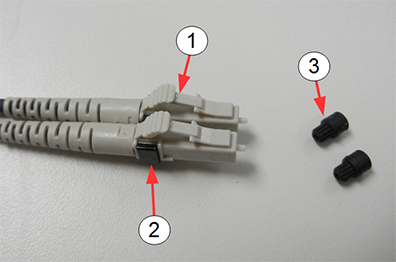
LC connectors are used with SFP fiber optic transceiverFigure 1. LC Connector
Item
Description
1
LC connectors
2
Black clip
3
Protective caps for ferrules
The LC connector is used with the SFP (small form-factor pluggable) optical transceiver. The SFP is a compact fiber optic transceiver used by multiple subsystems in an MR system for the transmission of data. These devices can transmit high rates of data without the concern of noise being induced in the fiber optic cables which join these devices.
The SFP is very sensitive to electrostatic discharge. When handling any of these devices, use proper ESD procedures to prevent early failure.
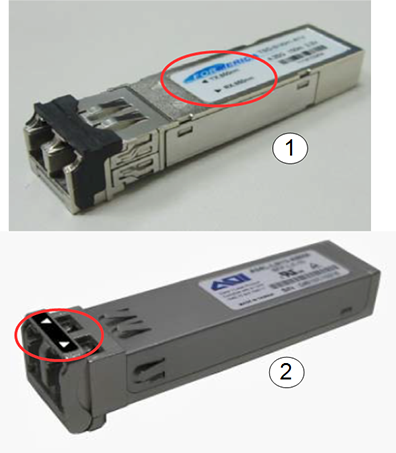
Figure 2. Small form-factor pluggable (SFP) fiber optic transceiver
Item
Description
1
Formerica SFP with Tx and Rx arrows on label
2
Applied Optoelectronics SFP with Tx and Rx arrows on bail