• SIGNA MR355 / SIGNA MR360
  • Service Manual
  • 5856356-3EN Revision 5.0
  • Basic Service Documentation. Copyright General Electric Company.
  • Object ID: 00000018WIA30206F20GYZ
  • Topic ID: id_13105789 Version: 1.3
  • Date: Jul 5, 2019 10:25:10 PM

PAC Leakage Current Test

Prerequisites

Table 1. Personnel requirements
Required personsPreliminary requirementsProcedureFinalization
1Not Applicable10 minutesNot Applicable
Table 2. Tools and test equipment
ItemQuantityEffectivityPart numberManufacturer
Dale 600/601 (120VAC) Safety Analyzer1-

46-328406G1

-
Dale 600E/601E (220VAC) Safety Analyzer1-

46-328406G2

-
Fluke ESA612 Electrical Safety Analyzer1-

5453348

-
Table 3. Safety

About this task

When Safety Analyzer Kits are sent in for calibration, the units are being upgraded with the Dale 601/601E Safety Analyzer (generally Americas and Asia) or the Fluke ESA612 Safety Analyzer (generally Europe).

This procedure is divided into three sections: first the Dale 600/600E; next the Dale 601/601E; and finally the Fluke ESA612.

Data Sheet for Recording Leakage Current Data

About this task

Use the supplied data sheet to record the leakage current data. Table 4 is a reference of what is contained on the data sheet. Print the form. 2087498.pdf

Table 4. PAC Leakage Current Measurements
LEAD SELECT POSITION METER READING NORMAL POSITION (microamps) METER READING REVERSE POSITION (microamps)
Patient (Lead to Ground) Leakage Current
Right Leg (RL)
Right Arm (RA)
Left Arm (LA)
Left Leg (LL)
Patient (Lead to Lead) Auxiliary Current
RL
RA
LA
LL
M.A.P. (Isolation Tests)
ALL LEADS M.A.P. Test

Using Dale 600/600E Safety Analyzer

Procedure

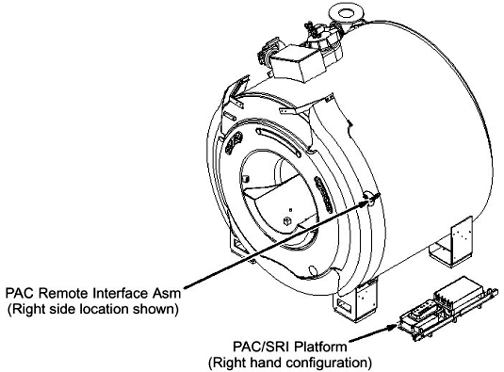
  1. Plug the Analyzer into a power source in the magnet room, which allows access to the PAC Remote Interface Assembly while staying at least 20 inches (51 cm) from the magnet.
    Figure 1. Location Of The PAC Remote Interface ASM For LCC/CX/K4 Magnet
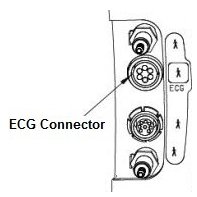
  2. At Physiological Acquisition Controller (PAC) Remote Interface Assembly, connect the Patient Lead cable and the Cardiac Lead Set at the ECG connector.

    The ECG connector is round and is labeled with “ECG” or a heart symbol.

    Figure 2. ECG Connector (Example)
  3. Connect cardiac leads to Dale 600/600E (46-328406G1). See Figure 3.
    Figure 3. Dale 600 Analyzer
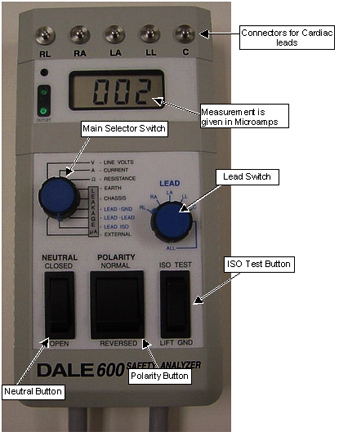
  4. Place the Neutral Button in the CLOSED position.
  5. Place the Polarity switch in the NORMAL position.
  6. On the Dale 600/600E set the main selector switch to LEAKAGE - LEAD-GND.
  7. Move the LEAD switch through the positions shown in Table 5. Verify leakage current displayed on meter is less than 50 micro amps and record the values in the Data Sheet.
    Note:

    Typically the Lead to Ground and Lead-to-Lead readings are close to zero and less than 50 microamps. Measurements exceeding the 50 micro amps indicate an issue in the corresponding lead.

    Table 5. Leakage Current Measurements
    LEAD SELECT POSITION
    RL
    RA
    LA
    LL
  8. On the Dale 600/600E set the main selector switch to LEAKAGE - LEAD-LEAD.
  9. Move LEAD switch through the positions shown in Table 5. Verify leakage current displayed on meter is less than 50 micro amps and record the values in the Data Sheet.
  10. On the Dale 600/600E set the main selector switch to LEAKAGE - LEAD-ISO.
  11. Make sure that the leads are not touching the floor.
  12. Move the LEAD switch to ALL LEADS.
  13. Press button ISO TEST and record the meter reading in Data Sheet. This reading must be less than 50 micro amps.
  14. RepeatStep 5 -Step 13 with the POLARITY switch in the REVERSED position.

Using Dale 601/601E Safety Analyzer

Procedure

  1. Plug the Analyzer into a power source in the magnet room, which allows access to the PAC Remote Interface Assembly while staying at least 20 inches (51 cm) from the magnet.
    Figure 4. Location Of The PAC Remote Interface ASM For LCC/CX/K4 Magnet
  2. At Physiological Acquisition Controller (PAC) Remote Interface Assembly, connect the Patient Lead cable and the Cardiac Lead Set at the ECG connector.

    The ECG connector is round and is labeled with “ECG” or a heart symbol.

    Figure 5. ECG Connector (Example)
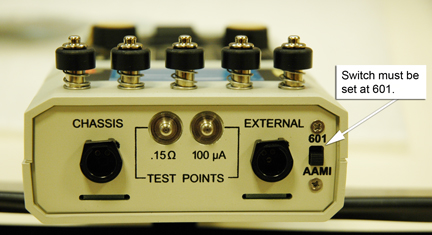
  3. Verify that the Test Load selector switch is set at 601 for IEC601.1. See Figure 6.
    Figure 6. Test Load Selector Switch Setting
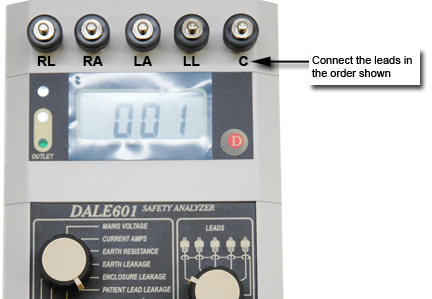
  4. Connect the ECG leads to Dale 601/601E. See Figure 7. Not all systems will have the Cardiac (C) lead.
    Figure 7. Dale 601/601E Analyzer: Connecting Leads
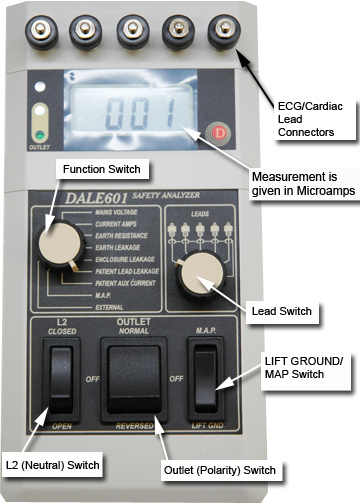
  5. Place the L2 (Neutral) Switch in the CLOSED position. See Figure 8.
    Figure 8. Dale 601/601E Safety Analyzer
    Note:

    Be sure to pause in the OFF (Middle) position when switching polarity from normal to reverse

  6. Place the Outlet (Polarity) switch in the NORMAL position.
  7. On the Dale 601/601E set the Function Switch to PATIENT LEAD LEAKAGE.
  8. Move Lead switch through the lead positions shown in Table 6. Verify leakage current displayed on meter is less than 50 micro amps and record the values in the Data Sheet.
    Note:

    Typically the Patient Lead Leakage (Lead to Ground) and the Patient Aux Current (Lead-to-Lead) readings are close to zero and less than 50 microamps. Measurements exceeding the 50 micro amps indicate an issue in the corresponding lead.

    Table 6. Lead Positions
    LEAD SELECT POSITION
    RL
    RA
    LA
    LL
  9. On the Dale 601/601E set the main selector switch to PATIENT AUX CURRENT.
  10. Move Lead switch through the lead positions shown in Table 6. Verify that the current displayed on meter is less than 50 micro amps and record the values in the Data Sheet.
  11. On the Dale 601/601E set the main selector switch to M.A.P. (Mains on Applied Parts sink current).
  12. Make sure that the leads are not touching the floor.
  13. Move the Lead switch to measure All Leads, which is the 6th position all the way to right on the switch.
  14. On the LIFT/Ground/MAP Switch, press and hold M.A.P. Verify that the current displayed on meter is less than 50 micro amps and record the values in the Data Sheet.
    Note:

    Be sure to pause in the OFF (Middle) position when switching polarity from normal to reverse.

  15. RepeatStep 7 -Step 14 with the polarity switch in the REVERSED position.

Using Fluke ESA612 Safety Analyzer

Setting up Fluke ESA612 Safety Analyzer

Procedure

  1. Plug the Analyzer into a power source in the magnet room, which allows access to the PAC Remote Interface Assembly while staying at least 20 inches (51 cm) from the magnet.
    Figure 9. Location Of The PAC Remote Interface ASM For LCC/CX/K4 Magnet
  2. At Physiological Acquisition Controller (PAC) Remote Interface Assembly, connect the Patient Lead cable and the Cardiac Lead Set at the ECG connector. .

    The ECG connector is round and is labeled with “ECG” or a heart symbol.

    Figure 10. ECG Connector (Example)
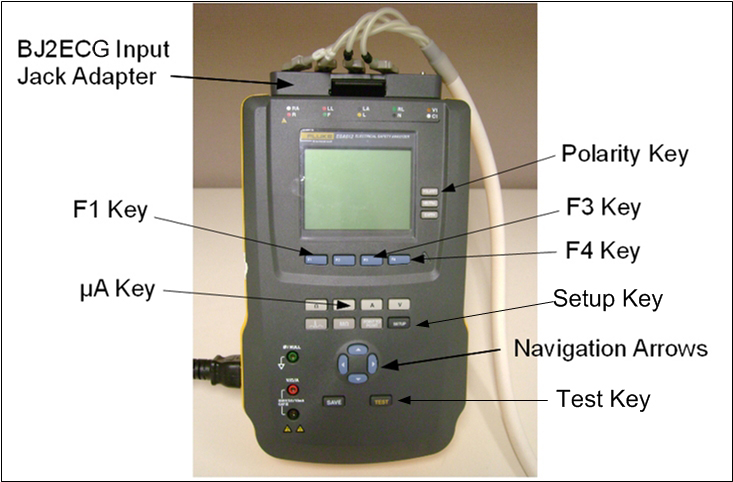
  3. Attach the Fluke BJ2ECG Input Jack Adapter to the Fluke ESA612 Safety Analyzer.
  4. Connect the ECG leads to the Fluke BJ2ECG Input Jack Adapter, matching:
    • Right Arm (RA) lead to RA Input Jack Adapter

    • Left Leg (LL) lead to LL Input Jack Adapter

    • Left Arm (LA) lead to LA Input Jack Adapter

    • Right Leg (RL) lead to RL Input Jack Adapter

    The fifth Input Jack Adapter, Cardiac (C), is not used for these tests.

    Figure 11. Fluke ESA612 Safety Analyzer
Testing Lead to Lead with the Fluke ESA612 Safety Analyzer

About this task

Note:

Detail of [F1] ~ [F4] Key selection will be shown on the display.

Procedure

  1. Turn on the Fluke Safety Analyzer.
    Note:

    At facilities with 110-120 VAC, a fault error may appear when you power the meter on. Press F4 OK to clear the error, and continue.

  2. Select SETUP.
  3. Select F4 (More...).
  4. Select F2 (Instrument).
  5. Select F1 (Standard).
  6. Press (up arrow) until 60601 is visible.
  7. Select F4 (Done).
  8. Select μA to start the leakage test.
  9. Select F3 (Patient Auxiliary).

    The display shows polarity as OFF and neutral is blank, earth is closed.

  10. Press Polarity.

    The display shows polarity as Normal, neutral is closed, earth is closed.

    Note:

    The Polarity button has a switching time delay of 1 to 5 seconds. If the analyzer beeps, wait up to 5 seconds before changing polarity.

  11. Press (down arrow) to select DC Only.
  12. Press (right arrow) to select the lead connection to test.
  13. Measure all 4 leads and verify that the leakage current displayed on the meter is less than 50 microamps. Record the values on the data sheet (see Table 4).
  14. Press Polarity until the display shows polarity as Reverse, neutral is closed, earth is closed.
    Note:

    The Polarity button has a switching time delay of 1 to 5 seconds. If the analyzer beeps, wait up to 5 seconds before changing polarity.

  15. Measure and record the values for the 4 leads again.

Testing Lead to Ground with the Fluke ESA612 Safety Analyzer

Procedure

  1. Select μA to start the leakage test.
  2. Select F4 (More...).
  3. Select F1 (Select).

    On the display, Patient should be highlighted. The display shows polarity as Reverse, neutral is closed, earth is closed.

  4. Press (down arrow) to select DC Only.
  5. Press (right arrow) to select the lead connection to test.

    The lead under test will be highlighted.

  6. Measure all 4 leads and verify that the leakage current displayed on the meter is less than 50 microamps. Record the values on the data sheet (see Table 4.
  7. Press Polarity until the display shows polarity as Normal, neutral is closed, earth is closed.
    Note:

    The Polarity button has a switching time delay of 1 to 5 seconds. If the analyzer beeps, wait up to 5 seconds before changing polarity.

  8. Measure and record the values for the 4 leads again.
  9. Select F2 (Mains on A.P.).

    The display shows Push Test: Normal.

  10. Press Test, and verify that the leakage current displayed on the meter is less than 50 microamps. Record the values on the data sheet (M.A.P. Isolation Tests).

    The display now shows Push Test: Reverse.

  11. Press Test, and verify that the leakage current displayed on the meter is less than 50 microamps. Record the values on the data sheet (M.A.P. Isolation Tests).

Finalization

Procedure

  1. Disconnect the Cardiac Lead Set from Safety Analyzer.
  2. Remove the Patient Lead cable from the ECG Connector.
  3. Unplug the Safety Analyzer.