
- SIGNA™ Hero 3.0T Service Methods
- 5852800-8EN Revision 1.0
- 00000018WIA30E70F20GYZ
- id_131064262.6
- Nov 2, 2021 1:41:42 PM
B0 Drift Calibration
Prerequisites
| Personnel requirements | |||
|---|---|---|---|
| Required persons | Preliminary requirements | Procedure | Finalization |
| 1 | - | 14 hours | - |
| Tools and test equipment | |||
|---|---|---|---|
| Item | Quantity | Part number | Manufacturer |
| Body TLT Loader for 3.0T | 1 | 2360037 | - |
| Service Foam Positioner | 1 | 5554839 | - |
| Required conditions |
|---|
| All other applicable calibrations must be complete. |
| System must be idle for a minimum of 2 hours before functional check. |
| Gradient Cooling Unit in ICC must be in operation while system is in idle for a minimum of 2 hours before functional check. |
About this task
Unwanted changes in the main magnetic field strength can occur when the spatially uniform field component is altered for a short term, during the process of scanning, or when the spatially uniform field component is permanently altered. This is known as short-term B0 drift. All MR systems that use passive shimming have B0 drift. However, the system with 3TLC magnet has a much higher drift (400 Hz per hour is reported from a engineering bay) because it uses a 3.0T magnet and is passive shim only. Other systems, such as MR750 and MR450w, have lower B0 drift (less than 30 Hz per hour).
With short-term B0 drift, the main magnetic field returns to its original value after scanning stops. Given sufficient non-active time, short-term B0 drift is reversible. However, too much short-term drift can have an adverse impact on image quality. It can cause an image intensity shift during fMRI, TRICKS, and VIBRANT MPH, and banding artifacts in SSPS-based sequences, such as FIESTA and COSMIC. Short-term B0 drift shall not exceed 30 Hz per 10 minutes. This requirement is for the 3TLC magnet design and the G3 magnet design, regardless of temperature variants.
The B0 Drift tool characterizes the B0 drift of a given magnet by monitoring the frequency of the system during a high power scan. The tool’s compensation factor is applied to any scan that affects B0.
B0 drift is directly affected by the amount of shim steel in the magnet. This calibration should be effective for the life of the system.
Procedure
- Place the TLT phantom and sphere on the flat table. Position the phantom in the center of the cradle and center it on the PA coil. To achieve the best test measurement, the phantom must be located in the center (long direction) of the cradle (landmark the center of phantom at 1080 mm from Home Position).Note: This image is a representative example. Actual systems may vary.
Figure 1. TLT Phantom and Sphere on Table 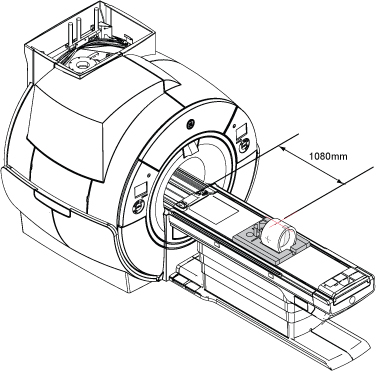
- Start the B0 Drift tool:
-
(For non-proprietary service tools) From the Common Service Desktop, select Calibration > B0 Drift Calibration. Select Click here to start this tool.
The B0 Drift window appears.
Figure 2. B0 Drift Window with X, Y, and Z Axes Highlighted 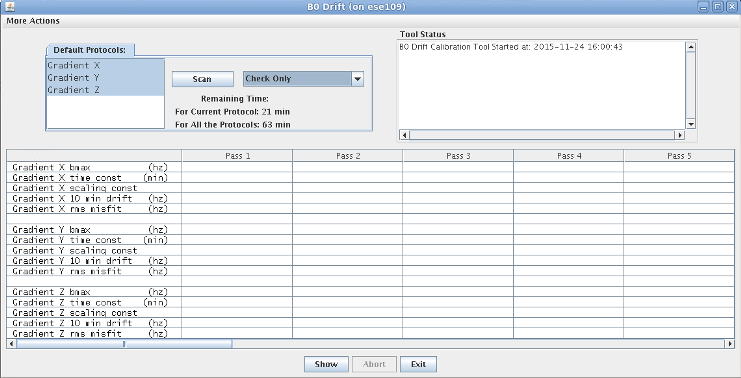
-
(For non-proprietary service tools) From the Common Service Desktop, select Calibration > B0 Drift Calibration. Select Click here to start this tool.
- When B0 drift calibration completes, a screen displays the data for each axis.
Figure 3. Data from B0 Calibration 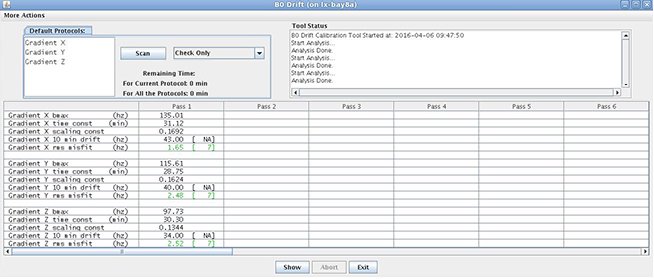
Finalization
Remove service equipment and phantom.