
- 00000018WIA30810130GYZ
- id_123737921.6
- Jan 17, 2020 11:09:43 AM
Patient Table Caster, Wheel and Pad Replacement
Prerequisites
| Required persons | Preliminary requirements | Procedure | Finalization |
|---|---|---|---|
| 2 | Not Applicable | 15-30 mins. per caster, 10 mins. per wheel kit | Not Applicable |
| Item | Quantity | Effectivity | Part number | Manufacturer |
|---|---|---|---|---|
| Nonferrous Level | 1 | - | - | - |
| 6.5 in. Block of Wood, minimum | 1 | - | - | - |
| Nonmagnetic Service Tool Kit | 1 | - | - | - |
| 3/8 and 7/16 in. Wrenches | 1 each | - | - | - |
| Snap ring pliers, found in the HEC cabinet. | 1 | - | - | - |
| Item | Quantity | Effectivity | Part number | Manufacturer |
|---|---|---|---|---|
| Loctite® 242 Threadlocker | 1 | - |
46–170686P1 | - |
| Alcohol Pads | 1 box | - |
46-183039P1 | - |
| Item | Quantity | Effectivity | Part number | Manufacturer |
|---|---|---|---|---|
| Wheel, Caster | 1 | - |
See FRU Manual. | - |
| Carefree Wheel Kit | 1 | - |
See FRU Manual. | - |
| Pedal Top Rubber Pad | 1 | - |
See FRU Manual. | - |
| ||||
Caster Removal
Procedure
- Remove the front or rear base cover.
Figure 1. Front and Rear Base Covers 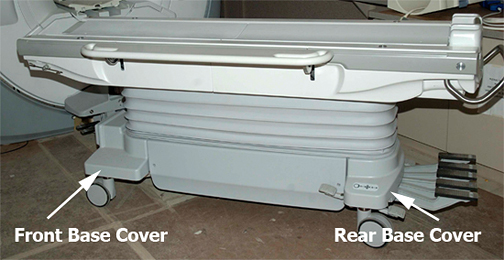
At the caster to be replaced, use a 3/8 in. wrench to remove the caster linkage pin.Notice Figure 2. Caster Linkage Pin, Collar and Bolt 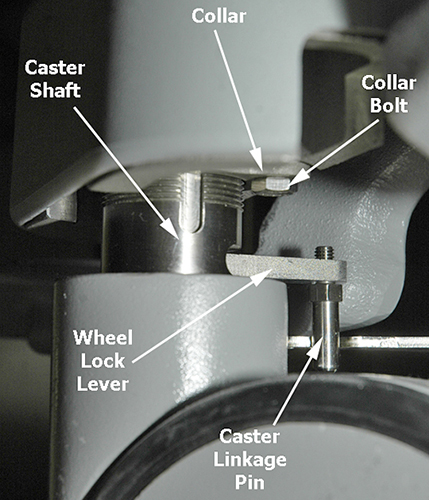 Note:
Note:Illustration depicts a floor-level view looking to the left from the right underside of the caster assembly. The orientation for each of the four casters is different so record the position of the collar and bolt hole while sliding the collar down the caster shaft.
- Looking from a top-down perspective, move the wheel lock lever
to the left.
Figure 3. Wheel Lever Lock Positions 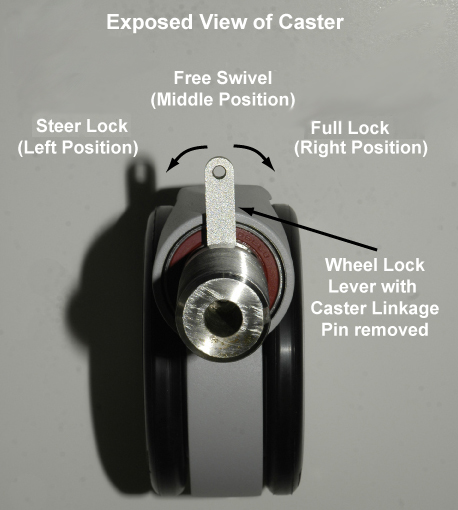
The wheel lock lever has three positions:
-
Full Lock or Brake is the right position that locks the caster so the patient table cannot move.
-
Free Swivel is the middle position that allows the caster to move freely.
-
Steer Lock is the left position that locks the caster in a direction, but the wheels can still spin.
-
- Use a minimum 6.5 in. block of wood to prop up the bottom of
the patient table to raise it at least 2.5 in. off the floor (to establish
enough clearance to remove a caster), and turn the caster counterclockwise
until it releases from the caster assembly.
Figure 4. Positioning Block of Wood at Front of Table 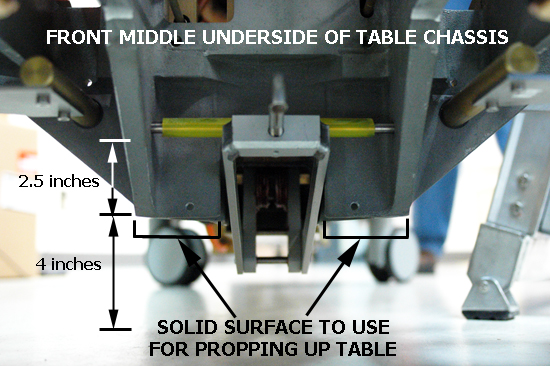
Figure 5. Positioning Block of Wood at Rear of Table 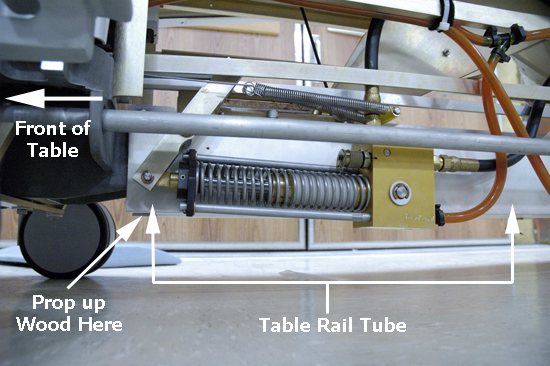
Caster Replacement
Procedure
- Attach the collar to the new caster, reusing the caster linkage pin, collar, and collar bolt from the old caster. (Refer to your note regarding the correct orientation of the collar on the caster shaft.)
Thread the new caster into the caster base by turning it clockwise.Notice - Return the table to all four casters on the floor, and measure the height of the new caster to achieve a measurement of 8.2 in. (207 mm). Refer to Leveling Patient Table. Use a nonferrous level to check the levelness of the patient table, and make the appropriate adjustments.
- Slide the collar up the caster shaft to its home position, wiggle the caster until the bolt holes line up, and rebolt the collar to the caster base.
- Apply Loctite 242 and replace the caster linkage pin on the new caster.
- Move the wheel lever lock to the free-swivel or middle position.
- Replace the caster base cover and patient table lower base cover.
- Dock the patient table and check the levelness.
Pedal Top Pad Replacement
Procedure
- Position and install the new rubber pad as shown below. (The
replacement is a self-adhesive backed rubber piece.)
Figure 6. Pedal Top Rubber Pad 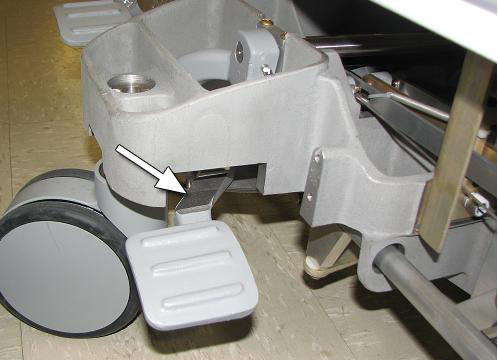
Wheel Replacement
Procedure
- Note:Use a snap ring pliers (1) to remove the snap ring (2) from the wheel.
The snap ring pliers can be found in the HEC cabinet.
Figure 7. Removing Wheel 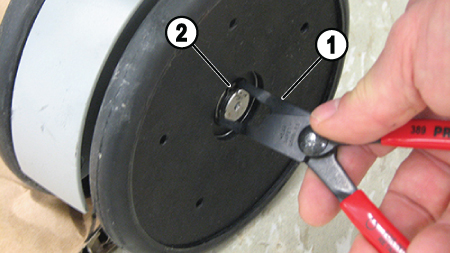
ITEM DESCRIPTION 1 Snap ring pliers 2 Snap ring
Finalization
Finalization
Ensure the caster brakes and steer lock work properly.