
- SIGNA MR355 / SIGNA MR360
- Service Manual
- 5856356-3EN Revision 5.0
- Basic Service Documentation. Copyright General Electric Company.
- 00000018WIA30062F20GYZ
- id_131070423.0
- Aug 29, 2019 1:53:50 AM
HD T/R Quad Extremity Coil SNR Test
Prerequisites
| Required persons | Preliminary requirements | Procedure | Finalization |
|---|---|---|---|
| 1 | Not Applicable | 15 minutes | Not Applicable |
| Item | Quantity | Effectivity | Part number | Manufacturer |
|---|---|---|---|---|
| Large cylindrical Unified Phantom | 1 | - |
5342679 | - |
| Phantom positioner | 1 | - |
5147225-7 | - |
| Condition | Reference | Effectivity |
|---|---|---|
|
Coil: QUADKNEE. Configuration: GE_HDX QUADKNEE. | - | - |
About this task
Follow this process to prepare for the SNR test using the HD T/R Quad Extremity Coil by Invivo. The SNR test process is the same (For 1.5T catalog, M3335ME) .
Phantom Setup
Procedure
- Place the baseplate of the coil on the patient table as shown
in the Figure 1.
Figure 1. Place the baseplate 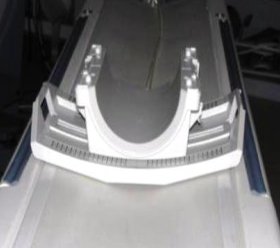
- Align the alignment mark on the coil to Zero position on the
Scale as shown in Figure 2.
Figure 2. Align the alignment mark 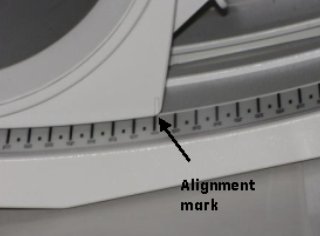
- Place the Phantom Positioner as shown in Figure 3.
Figure 3. Phantom Positioner 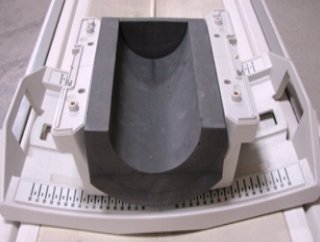
- Place the large cylindrical unified phantom in the phantom positioner
as shown in Figure 4.
Figure 4. Large cylindrical unified phantom 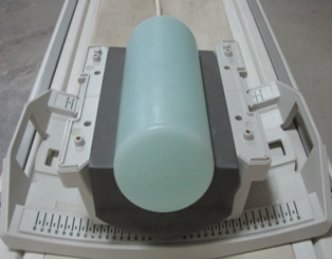
- Attach the anterior portion of the coil to the baseplate and
lock the coil as shown in Figure 5 and Figure 5.
Figure 5. Attach the anterior portion 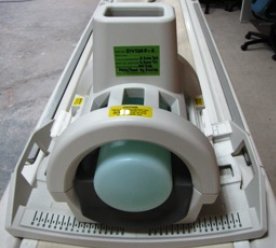
Figure 6. Lock 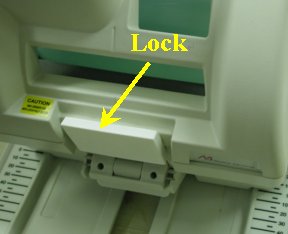
- Connect the Coil to respective port of the system LPCA and landmark
the coil on the marks shown in Figure 7. Then advance
to scan.
Figure 7. landmark 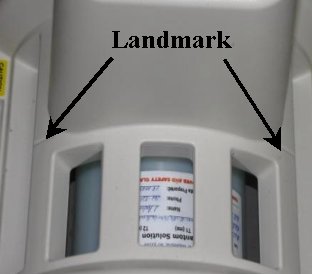
Coil Imaging Performance Verification
About this task
The GE HD T/R Quad Extremity Coil has one (1) coil name: HD T/R QUAD EXTREMITY, and can be used in the mode QUADKNEE . Refer to the Data Sheet in Step 1, to understand the data required to calculate the individual element SNR. The image quality check uses two different protocols for signal and noise image acquisition. The signal scan is an FSE sequence used to minimize susceptibility and B0 inhomogeneity effects. The noise scan is a GRE sequence that has a Control Variable (do_noise) to eliminate the transmit RF completely during the scan. The signal scan must be run prior to the noise scan as the R1, R2, and TG values from the signal scan are used for the noise scan.
Signal Scan
Procedure
- From the Scan Desktop, start new scan by selecting New Pt. Set Patient ID to geservice and Patient Weight to 111 pounds. Click Patient Position to open protocols window.
- At the console, set the protocols per the Signal section from Table 4, Signal and Noise Protocols.
- Click Save Series to download the protocols, then click Prepare to Scan.
- Run Auto Prescan. Take note of the R1, R2 and TG values.
- Run Scan.
Noise Scan
About this task
A signal scan must be run prior to the noise scan as the same R1, R2 and TG values must be used for both the signal and noise scans. Do not run an Auto Prescan prior to the noise scan as the values will be changed.
Procedure
SNR Measurement
Procedure
- Individual receiver SNR is defined as the mean of data within
the signal ROI divided by the standard deviation of data within the
noise ROI.
Figure 8. SNR Calculation  Note:
Note:The SNR calculation uses the MEAN of the signal image and STANDARD DEVIATION of the noise image.
Figure 9. Example ROIs 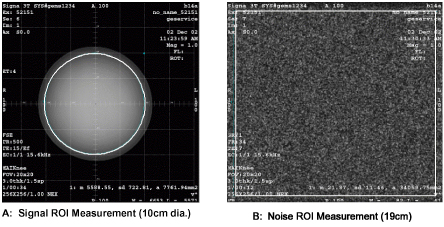
The SNR measurements must be greater than or equal to the following specifications:
Table 5. SNR Specifications Plane (if applicable) SNR (1.5T) HD T/R QUAD EXTREMITY Coil 200