
- SIGNA MR355 / SIGNA MR360
- Service Manual
- 5856356-3EN Revision 5.0
- Basic Service Documentation. Copyright General Electric Company.
- 00000018WIA30604F20GYZ
- id_131063472.0
- Jul 19, 2019 10:59:56 AM
Arc Flash Safety
Arc flash is a high-energy discharge of highly-conductive plasma, which can cause destruction to anything in its path. It is important to take the proper precautions when servicing energized equipment where voltage exceeds 50 volts. All unguarded equipment being serviced posing immediate exposure to voltages greater than 50 volts requires appropriate Personnel Protective Equipment (PPE) be worn. Arc flash hazards are very complex and different than electrical shock hazards. Many variables are associated with the causes of arc flash. As such, arc flash precautions are recommended for both energized and de-energized conditions. If in doubt, do not proceed and consult your EHS and technical specialists for guidance.
This document defines general guidelines, Lock Out/Tag Out (LOTO) steps, and minimum PPE required for arc flash avoidance when servicing the equipment. Devices such as, Main Disconnect Panels (MDP) and unguarded Power Distribution Unit (PDU) electrical connections, are examples of equipment requiring arc flash protection. The level of protection required is dependent on exposure potential.
Arc flash risks are recognized globally as a potential hazard. The approach to employee protection is guided by local regulatory requirements. In Europe, arc flash hazards must be addressed by conducting a risk assessment, which will result in the appropriate precautions and required PPE. In jurisdictions, including but not limited to the United States, Canada and Brazil, arc flash compliance requires training and specified PPE, dependent upon the anticipated hazard level.
Where regulations require specific PPE, the following is applicable:
-
Arc Flash PPE is required when working on live electrical components ranging from 50 to 480 volts.
-
Arc Flash PPE is also required during the zero-energy verification stage during LOTO. It must be assumed that there is still live electrical energy (and the potential for an arc flash) until verification with a voltmeter is completed.
| Notice | |
|---|---|
General Guidelines
Arc flash risks are recognized globally as a potential electrical hazard. Requirements and protective measures are guided by local regulatory requirements. In jurisdictions where PPE is specified, Hazard Class 1 or 2 PPE must be used.
-
Arc flash may occur when de-energizing or re-energizing electrical equipment. Precautions must be taken during both actions.
-
Comply with local regulatory requirements.
-
Follow PPE requirements as specified on the arc flash label if an arc flash label is present on the equipment. Otherwise, follow guidance as instructed in PPE Hazard Class Category 2.
-
If you do not have the required PPE, proper qualifications, and required training, or if a completed risk assessment has not been performed (in applicable jurisdictions), advise your supervisor. Arrangements must be made to have the work performed by qualified personnel.
The following training is provided by GEHC for FEs in MyLearning:
-
Electrical Safety
-
LOTO Authorized: Training Only, GE-EHS-CEP-34 or LOTO Authorized: Refresher, GE-EHS-CEP-34R as applicable
-
LOTO Authorized: Hands-On Demo, GE-EHS-CEP-38 or LOTO Authorized: Simulated Demonstration, GE-EHS-CEP-51 as per your organization’s practice
-
Personal Protective Equipment, GE-EHS-540 or Personal Protective Equipment Refresher, GE-EHS-540R
-
EHS Awareness for Field Service, GE-EHS-260
MDP Arc Flash Safety
-
MDP installation, service, or repair must be performed by a licensed or certified electrician.
-
GE Healthcare service personnel may perform live electrical calibration, testing, or troubleshooting on a GE MDP if all of the following conditions are met:
-
It is permitted by the customer and local code or regulation
-
Engineering risk assessment has been completed for the task, a released service procedure is available, and the PPE levels are defined
-
Electrical exposure is 480v or less (higher voltages always require a licensed electrician)
-
All equipment technical training is complete
-
Arc flash training has been completed
-
All LOTO training has been completed and LOTO skills are verified
-
Posted arc flash PPE requirements are met (if no arc flash PPE requirements are posted, then Level 2 is required)
-
Approved calibration, troubleshooting and test tools are used.
-
-
GE Healthcare service personnel are not permitted to:
-
Perform any work on a non-GE MDP
-
Perform any installation, service, or repair of any MDP (including changing batteries, tightening wires or nuts, or replacing fuses).
-
-
GE Healthcare service personnel should direct the customer to arrange for a licensed or certified electrician to perform any MDP maintenance or repair per the applicable MDP service manual available from the online documentation library.
Additional Lock Out/Tag Out Requirements
Follow the LOTO procedure for the equipment being serviced, including the steps below:
-
Prepare for the shutdown of the equipment.
-
Notify affected personnel working in the area that LOTO is being performed.
-
Shut down the MR system software per procedure.
-
Wear the appropriate Arc Flash PPE, Hazard Class 1 or 2 (as applicable), or take the precautions as required by local regulatory requirements.
-
De-energize the piece of equipment being serviced, and apply LOTO.
-
Assure that any stored energy in the equipment has been relieved, dissipated, drained, or otherwise controlled.
-
While wearing appropriate PPE (as applicable), verify zero energy on the equipment.
-
While wearing appropriate PPE (as applicable), remove LOTO and re-energize the equipment.
Personal Protective Equipment (PPE) Requirements
Wear the appropriate PPE under these conditions:
-
If directly exposed to 50 volts and above (AC or DC).
-
If there are arc flash warning labels posted on electrical panels (examples below).
Figure 1. Arc Flash Warning Labels 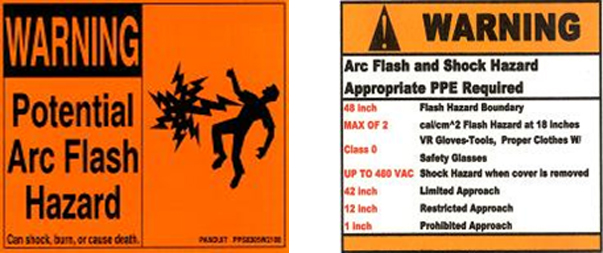
-
If arc flash warning labels are not posted, default to PPE outlined in the local codes.
-
When validating zero energy in electrical panels after applying LOTO.
-
When performing energized PDU testing or troubleshooting.
-
When performing A1/480 panel work.
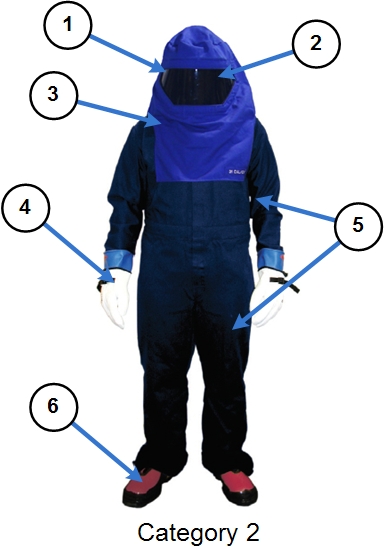
Below are illustrations of the types of Hazard Classes that may be addressed on an arc flash label (Category 1 and 2 for PPE.)
Arc Thermal Performance Value (ATPV), a measure to assess flame retardancy of clothing, is not recognized as a measurement criterion in Europe. Any PPE used in Europe must have a CE rating. Always follow local regulatory requirements.
GE Service Personnel are not permitted to work install, service, or maintain the MDP (including battery replacement) or PDU. Work must be performed by qualified electricians.
Testing or troubleshooting may be permitted if the GE Service person has completed all appropriate training and has proper PPE.
| Tasks Requiring PPE | Hazard Risk Category |
| When energizing or de-energizing circuit breakers or switched fuse operation with system covers on | 1 |
| Opening covers to expose bare, energized parts on the primary side of the system | 2 |
| All operations in the range of 50 to 240 volts unless otherwise stated | 1 |
| All operations involving exposed, unguarded surfaces greater than 240 volts | 2 |
| Installation, service, or maintenance of the MDP or PDU | Not Permitted |
| *The work descriptions assume equipment is energized, and work is done within the Flash Protection Boundary. | |
All activities would involve working with less than 10 kA short circuit current. The Hazard Level is calculated based on no more than 25 kA short circuit current available 0.03-second (two-cycle) fault clearing time.
PPE Hazard Class Category 1
| Notice | |
|---|---|
|
PPE Hazard Class Category 2
| Notice | |
|---|---|
|
|