Leveling Patient Transport
Prerequisites
This procedure is applicable to the following table products:
-
Signa Lightweight Patient Transport Table
-
Signa Oncology Patient Transport Table Option
-
Signa OR-Compatible Patient Transport Table Option
The Patient Transport is leveled to the magnet by adjusting the caster height. However, caster height must also be checked for uniform loading.
1 Adjusting Patient Transport for Floor Levelness
The first step in leveling Patient Transport is to adjust the casters to compensate for an uneven floor at the front of the magnet.
Procedure
- Dock the Patient Transport. If the docking mechanism is not properly adjusted, position the Patient Transport in its final location when docked.
- Lock the caster brakes.
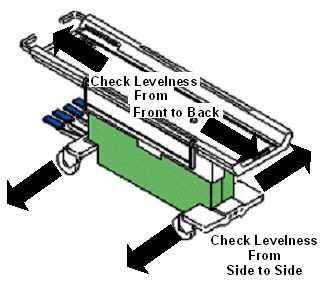
- With table top in the fully raised position, check the Patient
Transport for levelness: Front to Back at table top level and Left
to Right at the front and rear base castings as shown below.
Figure 1. Checking Levelness of Patient Transport
- Make sure all casters are sharing the load equally:
- Apply a small lifting force at each corner of the table to check if the caster easily lifts off the floor.
- If one caster or two diagonally mounted casters do not seem loaded as much as the other casters, adjust accordingly.
2 Checking Caster Height Adjustment
Procedure
- To keep track of measurement data, label each caster: Start with the steering caster (green-colored locking tab) as 1 and proceed in a clockwise direction, labeling the next casters 2, 3, 4.
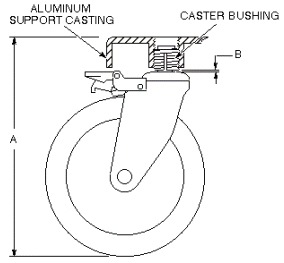
- At each of the four caster wheel assemblies, measure the height
from the floor to the top of the aluminum support casting (shown in
illustration below as “A”).
-
Record this measurement in Table 4 in the Measurement A, 1st Height column.
-
This height should be 11.0 in., ±0.250 in. (279.4 mm, ±6.4 mm). If not within tolerance, calculate the out-of-tolerance amount (- if caster height is too small; + if height is too large), and record this value in the Measurement A, 1st Delta column.
Figure 2. Caster Measurements
 note:
note:Observe the following:
-
Tolerance for Measurement A: 11.0 in., ±0.250 in. (279.4 mm, ±6.4 mm)
-
Tolerance for Measurement B: <0.250 in. (<6.4 mm)
-
- At each of the four caster wheel assemblies, measure the gap
between the bottom of the caster bushing and the base of the caster
shaft. (See “B” in Figure 2.)
-
Record this measurement in the Measurement B, Gap column in Table 4.
-
The acceptable measurement for this gap is less than 0.250 in. (6.4 mm). If gap is not within tolerance, calculate the out-of-tolerance amount (- if gap is too small; + if gap is too large), and record this value in the Measurement B, Delta column.
-
3 Caster Mounting Design
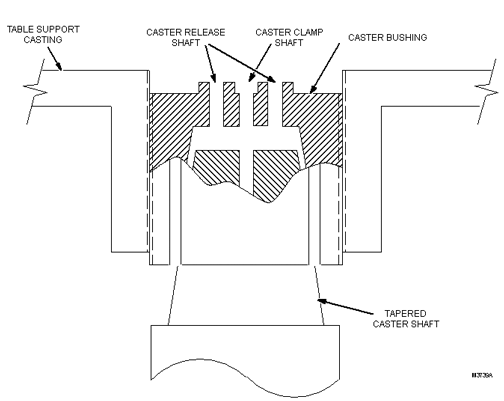
When the caster bushing can turn freely inside the aluminum support casting, the bushing provides a means of adjusting caster height.
-
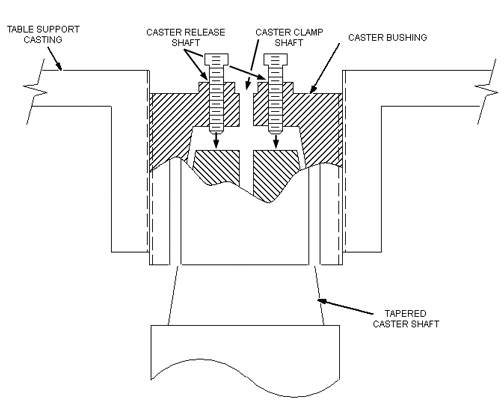
The Caster Bushing is slotted and has a tapered hole to accept the Tapered Caster Shaft shown below.
Figure 3. Caster Bushing and Tapered Caster Shaft
-
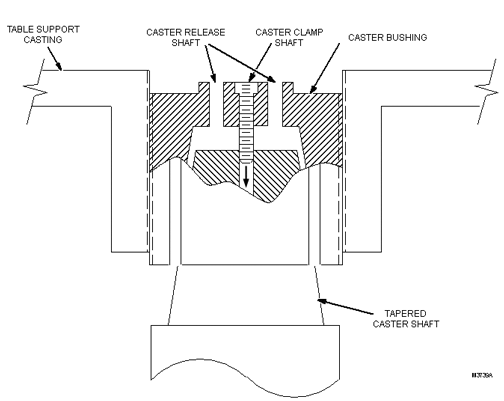
When a caster screw is inserted into the Caster Clamp Shaft and tightened securely, the screw allows the weight of the table to draw the shaft up into the Caster Bushing. This causes the bushing to spread tightly against the aluminum support casting threads, preventing the bushing from turning and changing the height adjustment. (See illustration below.)
Figure 4. Securing Screw in Caster Clamp Shaft
Procedure
- To adjust caster height, remove the screw from the Caster Clamp
Shaft, and place it in one of the other Caster Release Shafts. To
fill the second Caster Release shaft, remove the screw from the Caster
Clamp Shaft in one of the adjacent casters, and place that screw into
the other Caster Release Shaft. (See illustration below.)
Figure 5. Using Screws in Caster Release Shafts
 note:
note:As the screws are inserted into the Caster Release Shafts, they push the caster shaft out of its tapered fit in the caster bushing, leaving the bushing loose enough to turn and provide caster height adjustment.
- After adjustment, remove the screws from the Caster Release Shafts, and return them to their original Caster Clamp Shaft to prevent contact with the caster shaft. Once in the Caster Clamp Shaft, tighten the screw adequately to secure the caster shaft and immobilize the bushing. (See Figure 4.)
4 Problem Conditions, Causes and Solutions
There are two conditions that could cause the caster assembly to come loose and possibly fall off the Patient Transport.
Procedure
- Problem Conditions and Causes:
- The tapered caster shaft can become loose and back out of the caster bushing. This can be caused if a screw was left in the Caster Release Shaft, and the screw is pushing against the Tapered Caster shaft, preventing the shaft from seating securely into the bushing.
- The caster bushing can back out (partially or completely) from
its threaded hole in the support casting. If the tapered caster shaft
becomes loose (described in Step a), or the caster bushing was improperly
positioned during caster height adjustment, the bushing can back out
of the aluminum support casting.note:
The correct bushing positioning is detailed in the next section, Patient Transport Leveling.
- Solutions:
- When it becomes necessary to force the Tapered Caster Shaft out of the caster bushing during an adjustment procedure, two screws will be used in the vacant caster release shafts. One of the caster clamp screws will come from the caster being adjusted, and one borrowed from another caster assembly. (See Figure 5.)
- Using a 50 lb-in torque on the caster clamp screw will result in sufficient tightness of the caster bushing inside the aluminum support casting to prevent the bushing from backing out when the caster assembly swivels.
5 Patient Transport Leveling
Procedure
 warning
- Undock the Patient Transport and move it out of the Magnet Room.
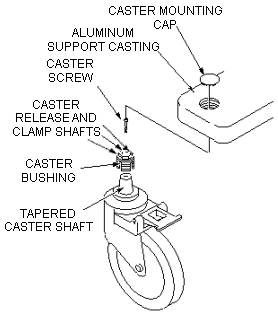
- On the first caster to be adjusted, remove the Caster Mounting
Cap (shown below) by prying it off with a small screwdriver.
Figure 6. Caster Wheel Assembly
- danger
- For each caster whose Measurement B is outside the required tolerance, twist the bushing to adjust this measurement to the amount recorded in Table 4.
- For each caster whose Measurement A is within tolerance as determined
in Table 4:
- Proceed to Step 19.
- If not within tolerance, proceed to the next step for caster height adjustment.
- On first caster to be adjusted, remove the screw from Caster Clamp Shaft, and thread the screw into one of the empty Caster Release Shafts turning the Caster Clamp Screw finger tight only.
- Go to another caster assembly, remove the screw from the Caster Clamp Shaft.
- Place the screw into the Caster Release Shaft of the caster being adjusted, and turn the second screw finger tight.
- Alternately turn the screws one turn at a time until the caster shaft is as loose as possible in the caster bushing.
- Using a means of leverage, slightly prop up the aluminum support casting of the caster being adjusted only enough to take the Patient Transport weight off the caster wheel. (This will disengage the caster shaft from the caster bushing, and prevent excessive wear on threads during adjustment.)
- Remove both screws from the two Caster Release Shafts.
- Adjust the caster height an amount equal to the value recorded
in the Delta column of Measurement A or Measurement
B (whichever applies) in Table 4.
-
While holding the caster wheel, use a 19 mm socket to turn the caster bushing counterclockwise to raise the table corner (for - Delta value), or clockwise to lower table corner (for + Delta value).
-
Each complete revolution of the caster bushing raises or lowers the caster 0.083 in. (2.1 mm).
-
- Remove the prop from under the aluminum support casting.
- Return one screw to the Caster Clamp Shaft in its original caster assembly.
- At the caster being adjusted, insert the remaining screw into the Caster Clamp Shaft.
- Using Torque Wrench 46-194427P255 and Socket Driver 46-307811P1, torque the Caster Clamp Screw to 50 lb-in. (If necessary, refer to the operating instructions supplied with the torque wrench.)
- Verify that the caster shaft is seated well into the caster bushing and the Measurement B, Gap is still within the tolerance defined in Table 4.
- Move the Patient Transport back into the Magnet Room and align to the dock. Do not actuate the docking pedal.
- For each caster, remeasure the Measurement A, Height and record
the value in the Measurement A, 2nd Height column
of Table 4.
- If this 2nd value of A is out of tolerance, calculate the amount by which it is out of tolerance, and record this amount in the Measurement A, 2nd Delta column.
- For each caster height still out of tolerance, adjust the height as determined by the value of the 2nd Delta in Table 4 beginning with Step 5.
- Move the Patient Transport back into the Magnet Room and align to the dock. Do not actuate the docking pedal.
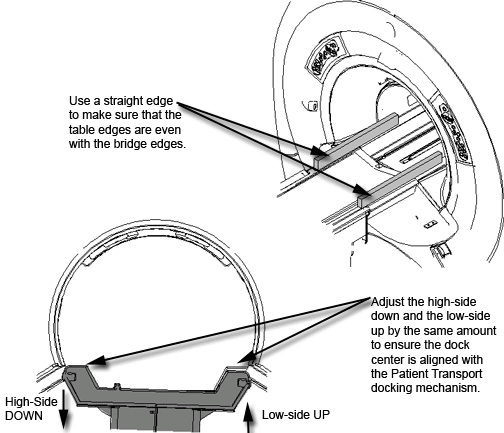
- Align the Patient Transport surface rotationally to the bridge (should be flush to 1 mm below the endbell surfaces) by raising the lower side casters per the instructions in Bridge Removal and Replacement.
- Be sure to lower the higher side casters by the same amount, as this will ensure the Patient Transport top will not be
shifted to one side of the bridge when docked, and the dock center
will align with the Patient Transport docking mechanism. (See illustration
below.)
Figure 7. Aligning Patient Transport Surface to Bridge
- When all caster height measurements are within tolerance and
the Patient Transport top is aligned to the bridge surface:
- Verify that each caster has one screw in the Caster Clamp Shaft and is torqued to 50 lb-in.
- Replace all the caster mounting caps.
- If necessary, complete Dock Centering and Dock Hardware Adjustments.
- Do not use the casters to adjust the Patient Transport top height. Follow the instructions in Table Top Height Adjustment.
 |
 |