- id_13106171
- Version: 4.1
- Date: Dec 3, 2019 12:38:10 PM
Echo Planar Test (EPT)
Prerequisites
| Required persons | Preliminary requirements | Procedure | Finalization |
|---|---|---|---|
| 1 | Not Applicable | 2 hours | 5 minutes |
| Item | Quantity | Effectivity | Part number | Manufacturer |
|---|---|---|---|---|
| 100 mm Sphere Phantom for 1.5T | 1 | - |
46-317586G1 |
- |
| EPI Foam Positioner, Body | 1 | - |
2170481 |
- |
|

The Echo Planar Test (EPT) combines the functionality of the B0 Dither Calibration and Group Delay Calibration into a single tool with a simple user interface. The output is suitable for remote support access, trending, and automatic checking of results against acceptance limits. EPT automatically updates the Echo Planar Image (EPI) calibration files.
Setup
Procedure
- Landmark on the center line of the head coil.note:
1.5T phantoms are light green.
3.0T phantoms are pink.
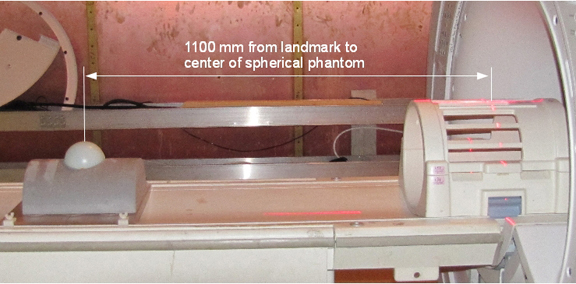
- Place an EPI Grafidy foam positioner and a 100 mm sphere in the positioner. Move the table into the bore to 1100 mm from landmark. Slide the Grafidy base plate so the center of the 100 mm sphere is at the axial alignment light, and then press the MOVE TO SCAN button.
Figure 1. Positioning phantom
Run EPT calibration tool
Procedure
- Start the Echo Planar Test calibration tool:
-
(For non-proprietary service tools) From the Common Service Desktop, select Calibration > Echo Planar Test. Select Click here to start this tool.
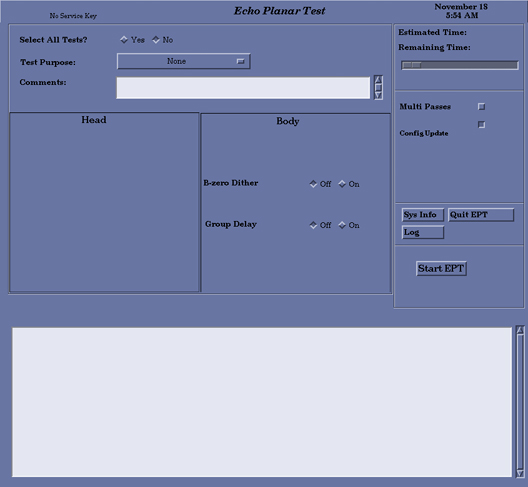
The Echo Planar Test window appears with partial test selection.
Figure 2. Echo planar test window (without service key)
-
(For non-proprietary service tools) From the Common Service Desktop, select Calibration > Echo Planar Test. Select Click here to start this tool.
- For calibration, set the Select All Tests? option to Yes.
The default is No.
For troubleshooting, select individual tests as desired.
- Two lines of Comments: can be entered, if desired. If no comments are entered, the text NO COMMENT is entered into the results file.
- Select a Test Purpose from the menu.
- For normal operation, the options buttons on the screen are
set correctly by default. You can change the options to suit the tests
you need to run.
- To perform more than one pass of the tests, select Multi Passes and enter a number in the text box.
- One or more of the selected tests can automatically update the configuration files with new calibration data if the new data is within specification. Select Config Update before starting EPT.
 caution
- Select Start EPT. Running all the tests
takes about 30 minutes and thoroughly tests the system’s EPI
performance.
While EPT is running, each test is displayed in the message window showing the amount of time the test requires to run.
note: For 1.5T systems, B0 Dither is run.
 |
Test Termination Procedure
Procedure
- When the tests are complete, one of the following messages appears:
- Your tests completed successfully.
- A serious system problem has been detected. This problem IS expected to impact image quality.
- EPT was unable to determine PASS/FAIL status of the tests.
- If the tests completed successfully, proceed to Finalization below.
- If the tests fail, open the Report Manager to view the test results and identify the failing tests.
- Select Quit EPT and confirm.note:
If the EPT process is not shut down in an orderly manner, the service protocol directions may need to be reset. Open a C-shell (click C Shell in the Service Desktop Manager) and enter the following:
/usr/g/bin/ept Enter
resetept Enter
Finalization
Procedure
- Continue with the next calibrations or do a SaveInfo.
- Reset TPS to bring the system back into a known state.
- Do a Doing a check scan to verify that the scanner is working properly before customer turnover.