- Topic ID: id_11039076
- Version: 3.0
- Date: May 23, 2022 11:23:47 PM
DoD16 Detector Theory
This module contains the following Sections :
-
Detector Overview – Detector Overview
-
Detector Module – Detector Module
-
Z-Axis Cell Summation – Z-Axis Cell Summation
-
Post Collimation: Z-Axis Beam Profile Considerations – Post Collimation: Z-Axis Beam Profile Considerations
-
Detector Cell to Output Channel Organization – Detector Cell to Output Channel Organization
-
Module HART Information – Module Hart Information
-
Detector Memory Board (DMB) – Detector Memory Board (DMB)
-
Detector Heater Control Board (DHCB) – Detector Heater Control Board (DHCB)
-
DoD16 Macro Row Compare with PDAS – DoD16 Macro Row Compares with PDAS
1 Detector Overview
DoD16 detector combines conventional detector function and DAS function. Innovation from previous detector is analog to digital (AD) conversion is conducted on detector. Convertor cards are disappear from DAS.
The primary function of the Detector is to convert X-Ray photons into electrical current, signal amplification and analog to digital conversion. Then digital signal is sent to the Data Acquisition System (DAS), before being sent to the Recon Unit for image reconstruction.
The x-rays pass through the patient (or object being scanned) and are attenuated by the density of material. The remaining energy of x-rays pass through to the detector. Wired collimation is used which improves the cross talk between rows.
Once the x-ray beam is collimated into cells/channels, the photons hit the scintillator pack, which causes it to emit light. The scintillator pack is made up of cast material and a GE exclusive material called Lumex. Lumex is an efficient x-ray absorbtion to light output material, with low afterglow characteristics. The light from the scintillator pack is then picked up by a photodiode array. The photodiode array converts the emitted light into an electric current, which is then passed through to the analog-digital convertor on detector module. The current strength is dependent on the amount of x-ray energy absorbed into the Lumex, which corresponds to the light energy output. There is a photodiode output from each detector cell.
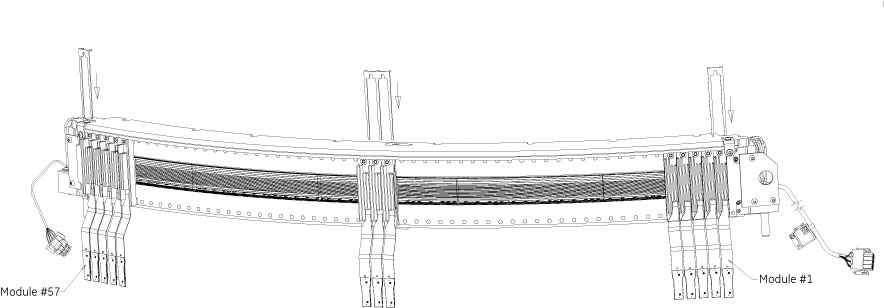
The detector assembly used on this system houses 57 Detector Modules (Figure 1). Each module has two sides (an A-side and a B-side) with twelve diodes or cells per channel per side. Cells are labeled A1/B1 through A12/B12, for a total of 24 rows across the detector face (both A and B sides). Note, there are sixteen (16) 0.625mm cells - eight (8) per side and eight (8) 1.25mm cells - four (4) per side. The 1.25mm cells comprise the four (4) outer rows on both A and B sides. Up to 24 rows per channel are active during any given data collection.
6 analog to digital conversion ASIC called “Vyper” are mounted on each module back side. Each ASIC associated 64 cells, one module has total 384 cells.
Each module uses one flex connections to the Data Acquisition System (DAS). The flex connectors cannot be removed from the module. The flex end is connected to the Interface Board (IFB). The flex lead and the DAS backplane are outfitted with female pin connectors. Each flex cable carries 6 digital signal lines, 4 clock lines, I2C lines, some ASIC control lines, analog/digital power & ground.
Detector module temperature is regulated by the electrical resistance heater and the thermistor. This is a 3 zone heater design. The heater and thermistor are incorporated into the detector assembly. The overall mass of the assembled detector system is approximately 25kg.
Figure 1. Detector Layout
2 Detector Module
Figure 2. Detector Module
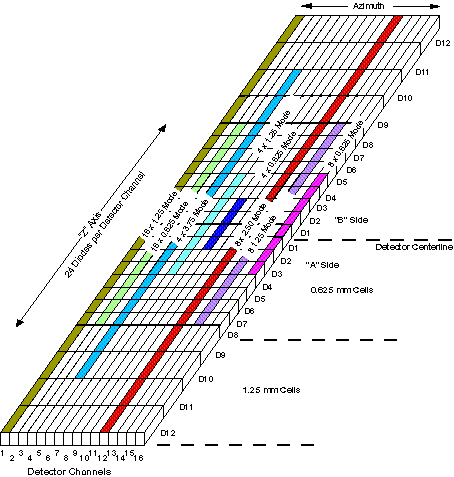
Detector Module: A detector module consists of a 16 x 24 pixel array.
Detector Channel: In total, there are 912 detector channels on a detector. A single channel is 1mm in length, in the azimuthal direction. A detector channel is sometimes referred to as a Detector Column.
Detector Row: A detector consists of 24 diodes arranged in the “Z” direction. A row of 16 cells across all detector channels designated by Diode Number AND Side. (Ex. Detector Row D2, Side “A”).
A Detector Row is not the same as a Scan Slice. A detector row is 1.25mm, 0.625 mm wide or a combination of the two (Z-Direction).
Cell: A cell is a single photodiode, and is 1/24th of a Detector Channel. In other words, there are 24 cells, or diodes, per Detector Channel.
Side A/B: There are 2 “sides” to a Detector, Side “A” and Side “B”. The sides divide the Detector width in half, with 12 Rows per side. Side “A” is closer to the front of the Gantry (or Table side) and Side “B” is toward the back of the Gantry.
3 Z-Axis Cell Summation
The detector is segmented into cells in the Z dimension. Post-patient collimation is provided by the segmentation of the detector cells, not by a separate post-patient collimator (see Figure 3). The post-patient collimation, along with summation of cells in the Z direction determines the Z-axis slice thickness of the scan data.
Figure 3. Detector Theory - X-Ray Collimation
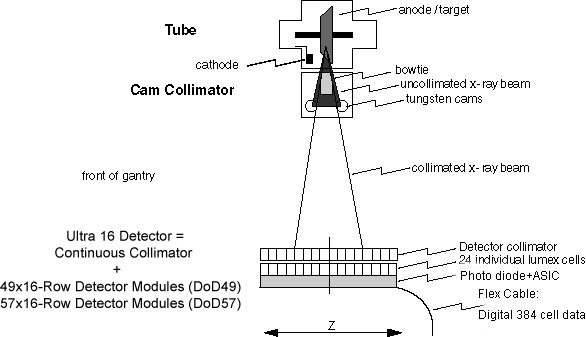
The Z dimension extent of each cell is 0.625 and/or 1.25mm at ISO center as determined by the selected protocol. Cells are summed in Z to produce a macro cell. Macro cells are the combination or ganging of cells in a detector column to produce the desired slice thickness. Four 0.625 mm cells equal a 2.5 mm macro cell, or two 0.625 mm and one 1.25 mm cells equal a 2.5 mm macro cell. The selected protocol determines the combination of cells that are summed together. The difference from LightSpeed 4.X series is DoD detector does not summed the combination of cells on detector hardware, since FET is not mounted on module. The slice summation is calculated on operator’s console. DoD detector output 0.625 mm by 16 slice and 1.25 mm by 8 slice at 20 mm detector configuration. DoD detector output desired slice thickness of 0.625 mm cells at equal or less of 10 mm detector configuration.
All macro cells in the same Z plane form a macro row. A macro row is the detector row or combination of rows that is used to generate a post-collimation slice thickness. A macro row consisting of a single cell in each column produces scan data with a thickness of 0.625 mm at ISO center. There can be up to 12 macro rows, labeled 12A, 11A, 10A, 9A, 8A, 7A, 6A, 5A, 4A, 3A, 2A, 1A, 1B, 2B, 3B, 4B, 5B, 6B, 7B, 8B, 9B, 10B, 11B, and 12B.
4 Post Collimation: Z-Axis Beam Profile Considerations
Figure 4. Z-axis X-ray Beam Profile, 4 x 0.625mm Detector Configuration
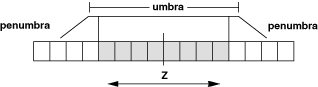
The collimated beam has a Z-axis profile that consists of the umbra (essentially flat) and the penumbra (sloped) (see Figure 4, highly idealized). In order to avoid image artifacts, the system must always operate with the umbra region completely covering the detector cells contributing to the selected macro rows. During gantry rotation, the position of the beam moves a small amount in the Z direction, due to various mechanical sags in the gantry, tube, collimator, etc. To ensure that the detector cells are completely covered by the umbra region, the Z dimension extent of the umbra is increased so that the detector is covered regardless of Z-axis beam motion (see Figure 4). This is true for standard protocol profiles.
Detector reference cells are used to estimate the actual position of the x-ray beam on the detector, and real-time feedback is provided to the collimator to compensate for beam motion.
All tracking schemes require a calibration of the x-ray beam optics. All tracking modes require prediction of the beam position based on the prescription. Static, predictive tracking estimates the beam position once per scan, based on prescription parameters such as gantry speed. Based on these parameters, the beam width and position in Z is estimated such that the detector cells selected are always covered by umbra. Closed-loop tracking provides more accurate control of the beam position in Z. This scheme uses detector reference cells to estimate the actual position of the x-ray beam on the detector and then to compensate for beam motion by providing real-time feedback to the collimator. In this scheme, the collimator corrects for beam motion many times per gantry rotation.
5 Detector Cell to Output Channel Organization
DoD57 channel organization is very simple, there are no ganging channels. The cells in module 1 are channel 1~16, the cells in module 57 are channel 897~912, module 1 and 49 are reference / T-Tracking.
Figure 5. DoD57 Detector to DAS Architecture Map

6 Module HART Information
Each module has own HART information in On-board EEPROM. The HART information includes module location, part number, revision, serial number, low performance pixel and so on. The information are used at calibration, FRDM wizard.
7 Detector Memory Board (DMB)
The DMB is used to store non-volatile information such as the detector memory board revision, which heater/cooler zones are enabled, and initial on/off temperature set limits. DMB is used to initialize DHCB.
The DMB consists of an I2C EEPROM, an I2C current buffer and input protection diodes. It also has a single connector with which it communicates to the DHCB. It is located on the detector-plate in the rotating gantry, between the D-case and E-case power supplies.
Figure 6. Detector Memory Board
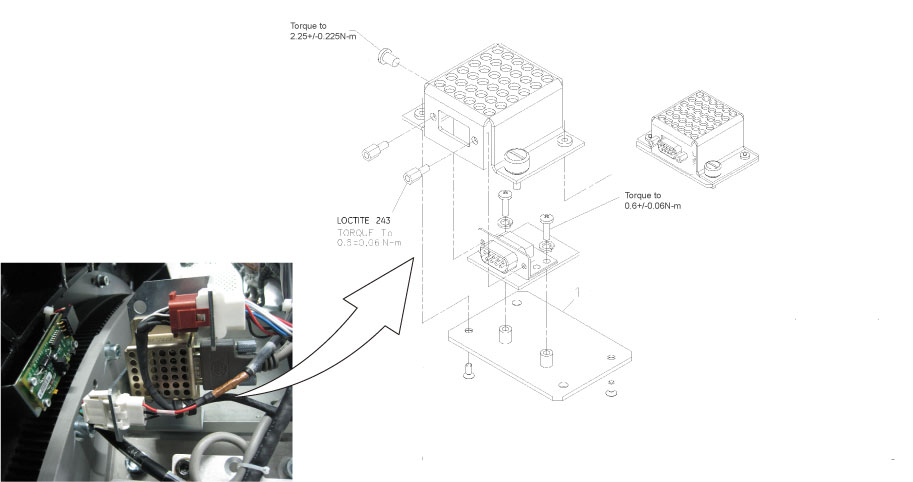
8 Detector Heater Control Board (DHCB)
Refer to Detector Heater Control Board (DHCB) Theory for DHCB theory introduction.
9 DoD16 Macro Row Compare with PDAS
Refer to DoD16 Macro Row Compare with PDAS.