Software and Formulae for RF Conversions
Software are described and formulae are presented in this section that will allow the FE to perform various conversions and calculations.
1 RF Conversion Software
1.1 RF Power Calculator
The first tool, the RF Power Calculator can be run from the Service Desktop Manager, open service browser and selectUtilities, then RF Calculator, and then Click here to start this tool on systems with 20.0 or greater software. Watts to dBm, dBm to Watts, relative volts to relative power, and relative power to relative volts conversions can be done with the RF Power Calculator tool.
1.2 Power Calculator Tool
The second tool is the Power Calculator. The tool is divided into 3 sections. The first section allows one to calculate RF power from measured peak voltage when using a 100 MHz oscilloscope and a properly characterized RF cables kit and dummy load. The second section provides Vpp to dBm, dBm to Watts, and dBm to Vpp conversion capability. The third section provides short instructions and a means for comparing the attenuation in dB reported on each RF Power Measurement Kit Card with the measured Magnitude Squared Attenuation Factor reported by the Attenuation Test tool that is described in DUMMY LOAD AND CABLES CALIBRATION.
2 RF Conversion Formulae
These are provided to assist the experienced FE with RF power
measurement and troubleshooting. The RF conversions below are presented
in two different formats. The first format is the actual mathematical
formula. The second format assumes that you are entering the data
into the system calculator exactly as you read it (Access the system
calculator by clicking  and then selecting the calculator from the menu.).
VP-P to dBm Calculation:
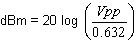
VP-P ÷ 0.632 =LOG* 20 = dBm.
dBm to VP-P Calculation:

dBm ÷ 20 =INV LOG* 0.632 = VP-P.
Example: Using 3.65 dBm, the Scope Power reading listed on a particular Kit card, and the system calculator to determine the equivalent Vpp:
3.65 ÷ 20 = (0.1825) INV LOG (1.5222991) * 0.632 = (0.9620931) VP-P.
dBm to Watts Calculation:

dBm ÷ 10 =INV LOG=* 0.001 = Total Watts.
3 1.5T Division Conversions
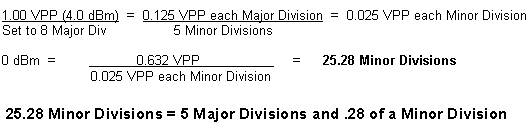
The 1.5T division conversion below may be useful for the FE using the RF Power Measurement Kit and attempting to measure a signal that requires more resolution that the "division" unit provides. These examples are provided as a general reference and are not intended to be used to perform the power monitor check.
1.5T Division Conversion example:
1.5T sites using the 1.5T Scope Calibrator and 100 MHz Oscilloscope equipment: