OSHA Lockout Tagout Requirements
The following may be required to perform Lockout Tagout:
Personal Lock: part # 46-194427P320
Figure 1. Personal Lock

Transition Lock: part # 2387081
Figure 2. Transition Lock

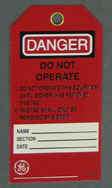
LOTO Tag: part # 2393068
Figure 3. LOTO Tag
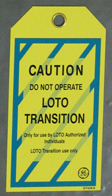
Transition Tag: part # 2393067
Figure 4. Transition Tag
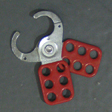
Multi-locking Device: part # 46-194427P313
Figure 5. Multi-locking Device
Line cord plug cover: part # 46-194427P231
Multi-meter Device: part # 46-194427P284
Figure 6. Multi-meter Device

Ball Valve LOTO Device: part # 5372868
Figure 7. Ball Valve LOTO Device

1 Scope
This standard covers the servicing and maintenance of machines and equipment in which the unexpected energization or start-up of the machine or equipment could cause injury to employee.
2 Application
This standard applies to the control of energy during servicing and/or maintenance of machines or equipment.
3 Exceptions
Minor adjustments and other minor service activities, which take place during normal operation, are not covered by this standard if they are routine, repetitive, and integral to the use of the equipment for operation, provided the work is performed using alternative measures that provide effective protection.
This standard does not apply to work on corded and plug-connected electric equipment. Exposure to the hazards of unexpected energization, or start-up, of such equipment is controlled by the unplugging of the equipment from the energy source, and by the plug being under the exclusive control of the employee performing the servicing or maintenance.
4 Purpose
Require employers to establish a program and use procedures for affixing appropriate lockout devices or tagout devices to energy-isolating devices, and to otherwise disable machines or equipment to prevent unexpected energization, start-up, or release of stored energy in order to prevent injury to an employee.
5 General Application
If an energy-isolating device is not capable of being locked out, use a tagout device. Such device shall be attached at the same location that the lockout device would have been attached.
6 Definitions
6.1 Energy-isolating device:
Mechanical device that physically prevents the transmission or release of energy (i.e., manually operated electrical circuit breaker or disconnect switch).
6.2 Energy source:
Any source of electrical, mechanical, hydraulic, pneumatic, chemical, thermal, or other energy.
6.3 Lockout:
Placement of a lockout device on an energy-isolating device, in accordance with an established procedure, ensuring that the energy-isolating device and the equipment being controlled cannot be operated until the lockout device is removed. It is also necessary to attach a tagout device to the lockout device.
6.4 Lockout device:
A device that uses a positive means such as a lock (either a single key or combination type) to hold an energy-isolating device in the safe position.
Any lock that uses a key to lockout a device must have only ONE key assigned to the lock owner.
6.5 Tagout:
Placement of a tagout device on an energy-isolating device, in accordance with an established procedure, to indicate that the energy-isolating device and the equipment being controlled may not be operated until the tagout device is removed.
6.6 Tagout device:
A prominent warning device, such as a tag and a means of attachment, that can be securely fastened to an energy-isolating device in accordance with an established procedure, to indicate that the energy- isolating device, and the equipment being controlled, may not be operated until the tagout device is removed.
6.7 Lockout / tagout:
If an energy-isolating device is not capable of being locked out, the site energy control program shall use a tagout system.
7 Application of Control
The established procedure for the application of energy control shall cover the following:
-
Preparation for shutdown
-
Machine or equipment shutdown
-
Machine or equipment isolation
-
Lockout or tagout devise application
-
Verification of isolation
Basic rule: All equipment shall be locked out or tagged to protect against accidental or inadvertent operation when such operation could cause injury to personnel.