- Topic ID: task_pxq_ns3_kjb
- Version: 3.0
- Date: Dec 29, 2020 1:03:22 AM
Quick Snap and IQ Snap Data Archive and Shipping Procedures
Prerequisites
Overview
This document defines the procedures to save Quick Snap data and/or IQ Snap data to USB disk(s), instructions for labeling the USB disk(s) and instructions for shipping the USB disk(s) to GE Healthcare for analysis.
The Quick Snap function provides the ability to collect data for troubleshooting System Level issues. The execution of the Quick Snap function can be found in the Learning and Reference Guide.
The IQ Snap function provides the ability to collect data and reserve scanfiles for troubleshooting Image Quality issues. The execution of the IQ Snap function can be found in the Learning and Reference Guide.
1 IQ Snap Data
This procedure assumes that an IQ Snap was executed, per the procedures in the Learning and Reference Guide, and the resulting files are ready to be saved to USB disk and send back to GE Healthcare for analysis. The IQ Snap function packages necessary data / log files into one directory for easy of archiving. The IQ Snap function also reserves the scan data files related to the selected images.
1.1 Scanfiles Saved to USB Disk
Procedure
- From the bottom of the Scan monitor, click the Recon Mgmt button. The Recon Management screen is displayed as depicted in Figure 1.
Figure 1. Recon Management Screen
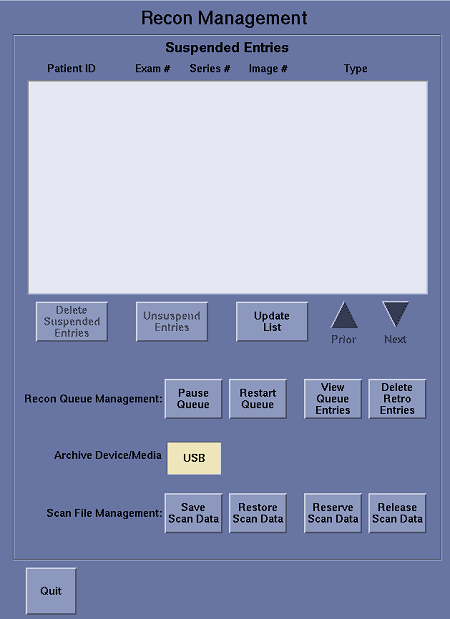
- From the Recon Management screen, click the USB button in the Archive Media section.
- From the Recon Management screen, click the Scanfile ManagementSave Scan Data button. The Recon Management Save Scanfiles screen is displayed as depicted in Figure 2.
Figure 2. Recon Management Save Scanfiles Screen
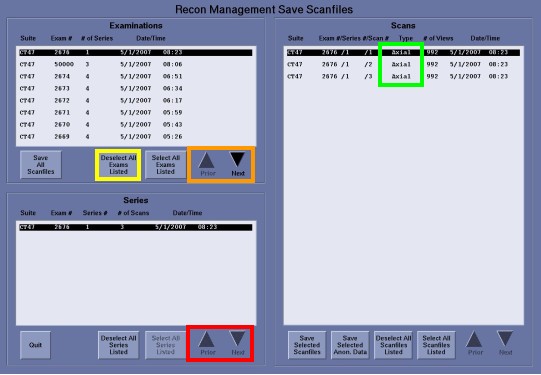
- From the Examinations pane of the Recon Management Save Scanfiles screen, click the Deselect All Exams Listed button (see Figure 2 yellow box).
- From the Examinations pane of the Recon Management Save Scanfiles screen, click the Next or Prior button (see Figure 2 orange box ) to locate the exam number of the scanfiles to be saved and then select the exam number entry.
- From the Series pane of the Recon Management Save Scanfiles screen, select the series number entry of the scanfiles to be saved. If there are multiple series displayed, press the Series pane Next or Prior button ( see Figure 2 red box ) to locate the series number.
- From the Scans pane of the Recon Management Save Scanfiles screen, determine whether the scanfiles to be saved are Axial type or Helical type (see Figure 2 green box )
- Insert a USB disk into the USB port.
- From the Scans pane of the Recon Management Save Scanfiles screen, select the scanfile(s) to be archived.
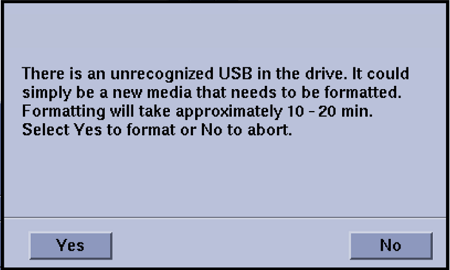
- From the Scans pane of the Recon Management Save Scanfiles screen, click the Save Selected Scanfiles or Save Selected Anon. Data button as depicted in Figure 3. During the saving process, a Saving Scanfiles pop-up box will be displayed on the Scan monitor and notice you need to format the USB disk (please backup the files in the USB in advance if needed), press Yes.note: Be sure to close other application processes before saving scanfiles. Failure to do so could cause a system crash and result in the data not being saved properly.note: The saving process time can take from a minute for an Axial scanfile up to 2 hours for a Cardiac Helical Scan.
Figure 3. Recon Management Save Scanfiles Screen Scans Pane
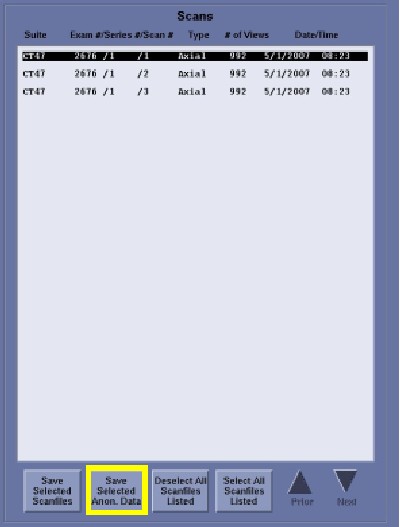
Figure 4. Pop window
- When the scanfiles are saved, a Scanfiles Saved pop-up box is displayed on the Scan monitor. Click the OK button in the Scanfiles Saved pop-up box.note:
- The format of the Scanfiles is like Iq.bj15.50018.1.1.scan.
- The Scanfiles will be saved in : /USB/service_usb_data/SFfiles/
- Remove the USB disk.
- Label the USB disk side with the following information:
- CSO / PQR Number
- Site Name
- System ID Number
- Host ID Number
- Current Date
- Date and Time of IQ Snap Creation
- Your Name and Phone Number
- Exam Number
- After all of the scanfile(s) have been saved to USB disk(s), from the Series pane of the Recon Management Save Scanfiles screen, click the Quit button. The Recon Management Save Scanfiles screen closes.
- From the Recon Management Main screen, click the Quit button. The Recon Management Main screen closes.
- At the Terminal window prompt, type exit and press Enter. The Terminal window closes.
- Forward the USB disk to GE Healthcare per instructions in Section Finalization.
1.2 Data / Log Files Saved to USB Disk
Procedure
- Insert a USB disk into the USB port.
- Click the ImageWorks button located in the Desktop / Status area (upper left corner of the Display / Image monitor).
- Click the Unix Shell - Left button located on the ImageWorks Desktop Toolbar (upper right corner of Display / Image monitor). A Terminal window appears on the Scan monitor.
- At the Terminal window prompt, type mountUSB and press Enter. The USB disk is completely mounted when the next terminal window prompt is displayed.
- At the Terminal window prompt, type cd /usr/g/service/log and press Enter. This changes the directory to /usr/g/service/log.
- At the Terminal window prompt, type cat sprsnap.log and press Enter. A list of information is displayed for each snap taken indicating type of snap, date and time of snap, full path to the snap contents and whether the snap completed successfully.
- From the displayed sprsnap.log information, locate the IQ directory name to be saved to the USB disk. The IQ-directory name has a structure of hostid.DateStampTimeStamp.iq. (Example: bay47.070412092735.iq, where DateStamp format is YYMMDD and TimeStamp format is HHMMSS).
- At the Terminal window prompt, type:
cp –R hostid.DateStampTimeStamp.iq
/USB/hostid.DateStampTimeStamp.iq
- Press Enter The IQ-directory is completely saved to the USB disk when the next terminal window prompt is displayed.
- Verify that the entire IQ-directory was saved on the USB disk by completing the following steps.
- At the Terminal window prompt, type:du –ch hostid.DateStampTimeStamp.iq
- Press Enter. This displays a list of subdirectory sizes of the IQ-directory and the Total size of the IQ-directory in bytes.
- Note the Total size value of the IQ-directory.
- At the Terminal window prompt, type:du –ch /USB/hostid.DateStampTimeStamp.iq
- Press Enter. This displays a list of subdirectory sizes of the IQ-directory and the Total size of the IQ-directory on the USB disk in bytes.
- The Total size value of the IQ-directory on the USB disk should be the same as the Total size value of the IQ-directory on the scanner. If they are not the same, repeat Steps above to complete it.
- At the Terminal window prompt, type:
- At the Terminal window prompt, type unmountUSB and press Enter. The USB disk is completely unmounted when the next terminal window prompt is displayed.
- At the Terminal window prompt, type exit and press Enter. The Terminal window closes.
- Remove the USB disk from the USB port.
- Label the USB disk side with the following information:
- "IQ Snap Data / Log Files" at top of Label
- CSO / PQR Number
- Site Name
- System ID Number
- Host ID Number
- Current Date
- Date and Time of IQ Snap Creation
- Forward the USB disk to GE Healthcare per instructions in Section Finalization.
2 Quick Snap Data / Log Files Saved to USB Disk
Procedure
- Insert a USB disk into the USB port.
- Click the ImageWorks button located in the Desktop / Status area (upper left corner of the Display / Image monitor).
- Click the Unix Shell - Left button located on the ImageWorks Desktop Toolbar (upper right corner of Display / Image monitor). A Terminal window appears on the Scan monitor.
- At the Terminal window prompt, type mountUSB and press Enter. The USB disk is completely mounted when the next terminal window prompt is displayed.
- At the Terminal window prompt, type cd /usr/g/service/log and press Enter. This changes the directory to /usr/g/service/log.
- At the Terminal window prompt, type cat sprsnap.log and press Enter. A list of information is displayed for each snap taken indicating type of snap, date and time of snap, full path to the snap contents, and whether the snap completed successfully.
- From the displayed sprsnap.log information, locate the INST-directory name to be saved to the USB disk. note: The INST-directory name has a structure of hostid.DateStampTimeStamp.inst. (Example: bay47.070412084337.inst, where DateStamp format is YYMMDD and TimeStamp format is HHMMSS).
- At the Terminal window prompt, type:
cp –R hostid.DateStampTimeStamp.inst
/USB/hostid.DateStampTimeStamp.inst
- Press Enter. The INST-directory is completely saved to the USB disk when the next terminal window prompt is displayed.
- Verify that the entire INST-directory was saved on the USB disk by completing the following steps.
- At the Terminal window prompt, type:du –ch hostid.DateStampTimeStamp.inst
- Press Enter. A list of subdirectory sizes of the INST-directory and the Total size of the INST-directory in bytes is displayed.
- Note the Total size value of the INST-directory.
- At the Terminal window prompt, type:du –ch /USB/hostid.DateStampTimeStamp.inst
- Press Enter. A list of subdirectory sizes of the INST-directory and the Total size of the INST-directory on the USB disk in bytes is displayed.
- The Total size value of the INST-directory on the USB disk should be the same as the Total size value of the INST-directory on the scanner. If they are not the same, repeat Steps above to complete it.
- At the Terminal window prompt, type:
- At the Terminal window prompt, type unmountUSB and press Enter. The USB disk is completely unmounted when the next terminal window prompt is displayed.
- At the Terminal window prompt, type exit and press Enter. The Terminal window closes.
- Remove the USB disk from the USB port.
- Label the USB disk side with the following information:
- "Quick Snap Data / Log Files" at top of Label
- CSO / PQR Number
- Site Name
- System ID Number
- Host ID Number
- Current Date
- Date and Time of Quick Snap Creation
- Your name and phone number
- Forward the USB disk to GE Healthcare per instructions in Section Finalization.
3 Finalization
Procedure
- To ship the Quick Snap and/or IQ Snap data USB disk(s) to GE Healthcare for analysis, securely pack the disk using anti-static foam, packing peanuts, or bubble wrap. To prevent unnecessary additional costs due to loss or damage of the package as it travels to GE Healthcare, ship via an insured carrier and obtain a tracking number for the shipment.
- Ship the Quick Snap and/or IQ Snap archived data USB disk(s) package to the following address:
MI & CT Systems Engineering
c/o GE Healthcare
3000 North Grandview Blvd.
Mail Stop W-1140
Waukesha, WI 53188