- Topic ID: id_17423372
- Version: 3.0
- Date: Apr 22, 2019 12:56:03 AM
X-Ray Theory Introduction
1 Functional Overview
The X-Ray generation subsystem is based on the "Jedi" platform. Jedi is the engineering name for a family of compact high frequency X-Ray generators. This generator family covers a wide range of applications from mobile equipment RAD/RF up to this state of the art CT system. The X-Ray generator in this system is capable of operating at a peak power of 72kW.
2 Architecture
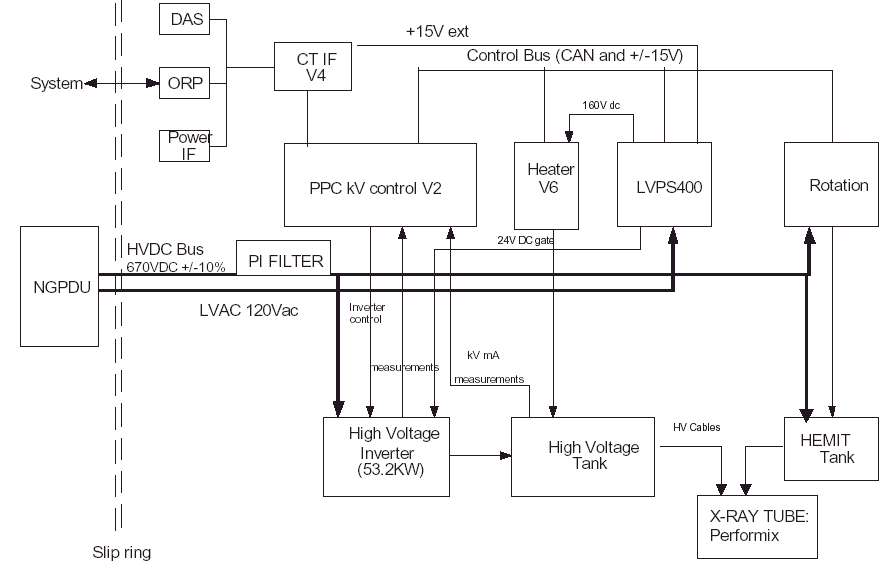
See Figure 1.
Figure 1. JEDI 60DC Functional Architecture
2.1 JEDI Core
The Jedi family is composed of:
-
High voltage chain composed of kV control, HV power inverter and HV tank
-
Anode rotation function
-
Tube filaments heater function
-
Control bus for communication between the functions
-
DC bus for power distribution to each function
-
Input voltage to DC conversion: AC/DC function
-
Low voltage power supply
-
Application software, running on the kV control board
These functions are the Jedi core. They are present in all versions of the generator.
2.2 Unique Functions
A function can be unique for all products or can be derived in several releases based on product specification.
Examples:
-
Anode rotation function is declined in two releases:
-
low speed rotation for applications where the tube is a 3000 rpm max tube
-
high speed/low speed rotation for applications where at least one of the tubes is a 8000-10000 rpm tube. (For Jedi 60DC, only high speed is used.)
-
-
Control bus is unique
3 System Packaging and Field Replaceable Units
The X-Ray generation subsystem has the following major FRU's, not including any collimator components.
-
X-Ray Tube (equipped with the following):
-
Heat Exchanger
-
Heat Exchanger Filter
-
Oil Pump
-
-
Three components (Power Unit, Auxiliary Unit, and HEMIT Tank) contain the following major FRU’s: