- Topic ID: task_syl_nbf_l3b
- Version: 4.0
- Date: Nov 8, 2021 5:11:43 AM
System State Save Restore
Prerequisites
Overview
The following procedures describe and illustrate the System State Save and Restore process. It is important to follow the steps listed below in order.
1 Save System State
Before proceeding with Save System State:
System State is a collection of system files saved in a directory structure. The system uses a default directory name (service_mod_data) on System State backup media. Whenever System State is saved to USB Flash Drive, the existing default directory (service_mod_data) is erased when Save All is selected. To avoid loss of a saved System State, on USB Flash Drive for example, rename the default directory with an unique name. (ex: System ID). When a specific System State backup is being accessed for restoring System State, the directory must be renamed back to the default directory name of service_mod_data.
Due to the default directory name and the directory size, it will not be practical to store multiple System States on a single USB Flash Memory Stick. For emergency backup, it's recommended that System State backups be transferred to a laptop or external USB Hard Drive. Use USB Flash Memory Stick only for the immediate saving and restoring of System State during Load from Cold.
Procedure
- Plug the USB Flash Drive into the Host Computer.
- Select: Service icon to access the Common Service Desktop (CSD).
- Click OK as required.
- Select: Utilities tab.
Figure 1. Common Service Desktop (CSD), Utilities Tab
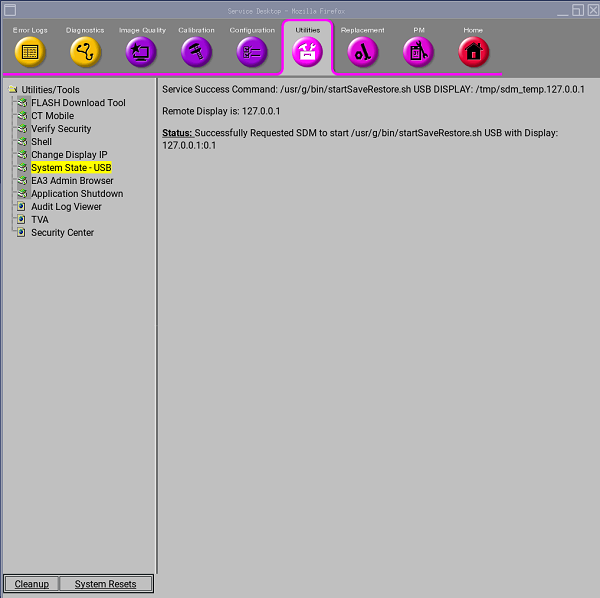
- Select: System State - USB for USB Flash Drive from CSD menu. The System State Save/Restore screen appears.
Figure 2. Save System State Window
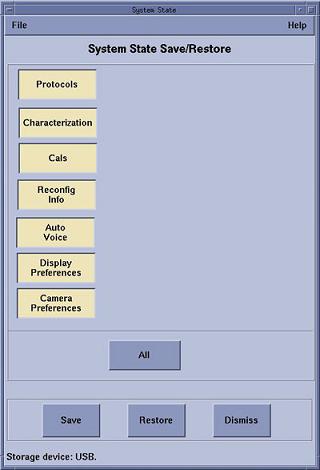
- Select All in the System State Save/Restore window.
- Click Save in the System State Save/Restore window. The System State Media Ready pop-up window appears.
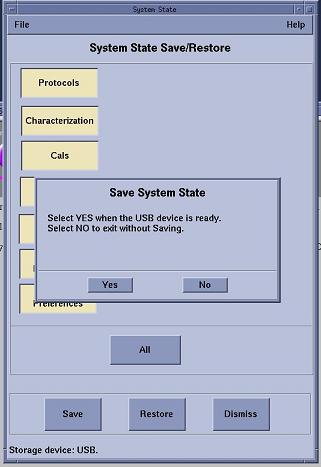
- Click Yes in the System State Media Ready pop-up window to start the save process.
Figure 3. System State USB Media Ready Pop-up Window
- Verify that the Save of System State was successful. A message at the end of the System State Message Log Window should state: Save/Restore System State: Completed Successfully.
Figure 4. System State Message Log Window
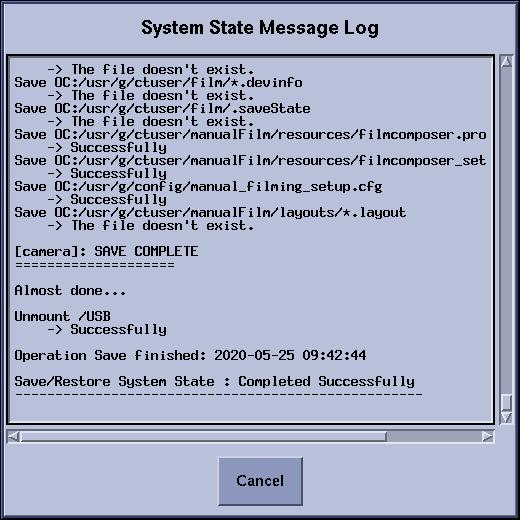
- When completed, click Cancel in the System State Message Log Window, then Dismiss in the System State Media Ready Pop-up Window.
- Close the Common Service Desktop window.
- Remove USB Flash Drive from USB port. Label System State Backup Media appropriately and place in a safe location.
2 Restore System State
Procedure
- Insert a previously saved USB Flash Drive into the Host Computer.
- Select the Service icon to access the CSD (Common Service Desktop).
- Select Utilities Tab.
- Select: System State - USB for USB Flash Drive from the menu. The System State Save/Restore screen appears.
- Select All in the System State Save/Restore window.
- Click Restore in the System State Save/Restore window. The Restore System State box appears.
- Click Yes in the Restore System State window to start the restore process.
- Verify that the Restore of System State was successful. If not, restore the System State again. A message at the end of the System State Log window should display: Restore System State Completed Successfully.
- When completed, click Cancel in the System State Message Log Window.
- Select Yes when the Scan Hardware Reset pop-up appears.
- When completed, select Dismiss.
- Remove USB Flash Drive from USB port and place in a safe location.
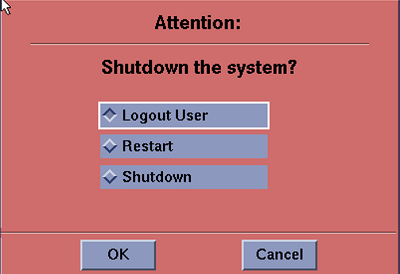
- Reboot the Operators Console by selecting Shutdown on the Desktop, then select Restart in the Attention Window.
Figure 5. System Shutdown Attention Window
3 Finalization
Procedure
- Verify Save System State.
Insert System State USB Flash Drive in any PC or Laptop Computer USB port and confirm System State files have been saved to the USB Flash Drive.
- Verify Restore System State.
- Visually verify that the system has the correct configuration and preference settings by opening a Terminal Window.
- Execute the system configuration script “reconfig”. Review and confirm settings, then press Quit.note: See System Configuration for detailed instructions on running “reconfig”.