- Topic ID: id_17479487
- Version: 1.0
- Date: Aug 28, 2018 3:53:02 PM
Gantry Service Balance Theory
1 Introduction
Gantry service balance is achieved by use of a service GUI tool, accessed from the common service desktop. The GUI steps through the process, providing all necessary instructions to the user.
GANTRY BALANCE MUST BE CHECKED FOR ANY COMPONENTS REPLACED ON OR REMOVED FROM THE ROTATING ASSEMBLY.
-
Why is balance necessary?
Having a non-symmetric weight load rotating causes gantry structural stress.
-
When to perform the balance procedure?
After every rotating gantry part replacement. Even tube alignments and power supply replacement will cause a change in the gantry balance condition.
2 Balance Terminology
There are two separate types of imbalance that may occur. The first is referred to as the static imbalance. The second is referred to as the dynamic imbalance.
2.1 Static Imbalance
A gantry is statically balanced when the center of mass (sometimes referred to as center of gravity) of the rotating assembly is on the axis of the bearing. When a gantry is statically imbalanced it will force the entire system to oscillate back and forth in the X direction with one oscillation per revolution of the rotating assembly. It will also oscillate up and down in the Y direction with one oscillation per revolution of the rotating assembly.
A system is statically balanced by adding weight to the rotating assembly, 180 degrees away from the “heavy side” or somehow removing weight from the “heavy side”.
2.2 Dynamic Imbalance
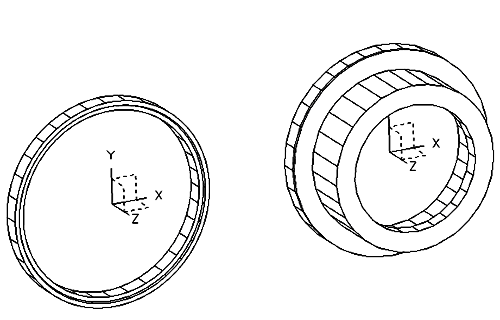
A gantry is dynamically balanced when the mass distribution is symmetric about an XZ plane passing through the center of mass as well as being symmetric about an YZ plane passing through the center of mass. Figure 1 and Figure 2 may make this clear.
Taking a simple example, the left side of Figure 1 shows a statically balanced bearing. The right side of Figure 1 shows where we have added a rotating structure to the bearing that is also statically balanced. We do not show the stationary structure that supports the bearing, but assume that it is in place. This assembly is also dynamically balanced due to the symmetry.
Figure 1. Balanced Bearing and Structure
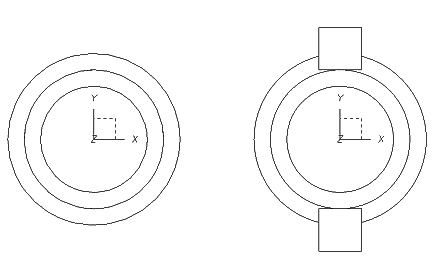
The left side of Figure 2 shows a view down the Z axis of this example. Now, we add two identical components to the structure, which are 180 degrees apart, as shown on the right side of Figure 2. This is statically balanced since the center of mass is on the bearing axis. But it is not clear whether it is dynamically balanced.
Figure 2. Static Balance
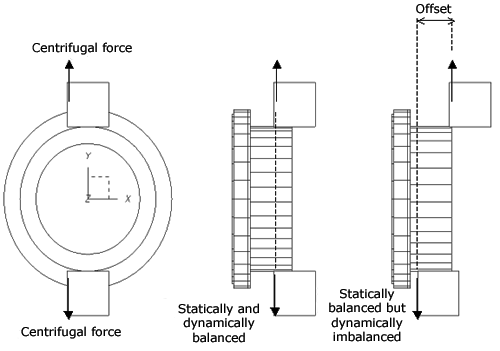
A side view illustrates this point. The middle sketch of Figure 3 shows a dynamically balanced situation since the two identical components are directly across from each other (have the same Z coordinate). The right side of Figure 3 shows a dynamically imbalanced situation. Here, the gantry tends to wobble as it is rotated. The Pre-LightSpeed gantries were not dynamically balanced and the wobble was often visually apparent.
Figure 3. Dynamic Imbalance Shown on Right Hand Side
3 Gantry Balance Process
Please refer to Gantry Balance Procedure
3.1 Risks of False Results
The gantry balance routine may fail to balance the gantry if the procedure is not followed properly. Examples of issues that will cause the gantry balance routing to fail are:
-
Incorrect reference weight placement.
-
Incorrect torque of trim weight fasteners.
3.2 Risk of Severe Gantry Damage
Gantry damage can occur if proper procedures are not followed. Examples of problems that fall in this category are:
-
Incorrect installation of weights.
-
Using threaded rods to manually rotate the gantry.
-
Incorrect torque of trim weight fasteners.
4 Torque Questions/Answers
4.1 Why is Torque Critical for Gantry Weights?
The proper torque on the gantry weight nuts is critical due to the forces exerted on the weights during rotation.
For a 0.4 second scan, the load capacity of the threaded rods needs to be:
-
@107 degree location at least 18000 lbs (8165 kg).
-
@180 degree location at least 7000 lbs (3175 kg).
4.2 Why is 160 N-m (118 ft-lb) of torque needed?
To be certain that friction carries the centrifugal force of the balance weights instead of the threaded rods. The next section will help us to understand the kinds of loads that can be carried by the rods and will then explain the importance of preload and friction.
5 Definition of Loads on the Threaded Rods
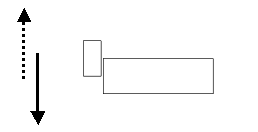
In the following illustrations, the applied load is drawn as a solid-line arrow and the reaction load is drawn as a dotted-line arrow. The reaction load is the load that opposes the applied load.
5.1 Tensile Load
Tensile load is the direction of the preload in the rods when they are tightened. See Figure 4.
Figure 4. Tensile Load

5.2 Shear Load
In Figure 5, note that the applied shear load and the reaction load, which act across the threaded rods, are close together. For a given cross-sectional area, threaded rods are only half as strong for a shear load as compared to a tensile load. The offset shown indicates the failure mode.
Figure 5. Shear Load
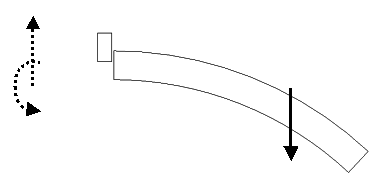
5.3 Combined Shear and Bending Load
In Figure 6, the applied shear load and the reaction are far apart. The threaded rods are considerably weaker in this case compared to a shear load alone. How much weaker depends on the offset distance (i.e. moment arm) between the applied load and the reaction.
Figure 6. Combined Shear and Bending Load
5.4 Loads on the Balance Threaded Rods
The threaded rods in the 107 degree and 180 degree balance stacks would be loaded in combined shear and bending, if the preload in the rods were small. This is shown in Figure 7. As stated above, threaded rods are weak in combined shear and bending. In fact, the threaded rods cannot carry the loads from the balance weights directly. They will eventually fracture under the load.
Figure 7. Combined Shear and Bending Load
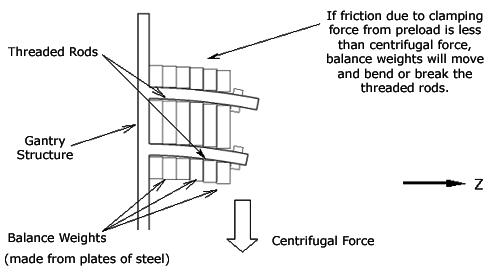
However, we have intentionally specified a high preload for the threaded rods so that friction between the weights will carry the centrifugal force. This drastically reduces the shear and bending load directly on the rods. But again, the preload needs to be high, but not too high as this will fracture the rods in tension. A torque of 160 N-m (118 ft-lb) is the optimal value to achieve the desired results.
Why were the threaded rods oriented in this way? The Z adjustment of the center of mass is needed for achieving dynamic balance. This means the axis of the threaded rods needed to be along the Z direction so that the center of mass of the balance weights can be shifted forwards or backwards in the Z direction. This adjustment is made possible by placing aluminum spacers and shims, which have little mass, between the gantry structure and the steel balance weights. More or less aluminum spacers and shims can be used to shift the weight of the heavy steel plates as needed. And as before, friction between all the elements carries the centrifugal force when the preload is as specified.
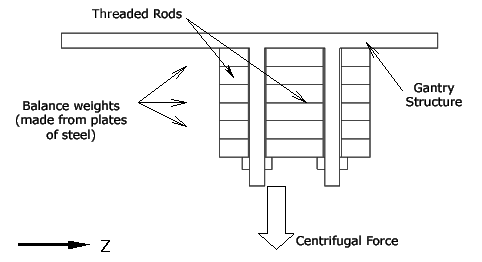
Had there not been a requirement to be able to adjust the center of mass in the Z direction, we could have used a more conventional loading on the threaded rods. This is shown in Figure 8 where it can be seen that the threaded rods would have had only tensile loading. A frictional load between the balance weights would not be as critical. In fact, the threaded rods could have been smaller in size and would have still safely carried the centrifugal force.
Figure 8. Tensile Load Only
6 What Do the Gantry Balance Specifications Mean?
There are different Gantry balance specification levels that are used depending on whether you are balancing the gantry or just checking the current balance status during Fastcal or Detailed Cal.
When performing the gantry balance process, the results are checked against a very tight factory specification and a lesser field specification. Systems in the field are allowed a less stringent specification than the tightly controlled manufacturing environment. Both specifications are considered “balanced” with regards to the system needs for scanning at a customer site. Manufacturing has the ability to use this same program so the extra manufacturing (or Factory) specification is displayed along with the Field specification. The system is calibrated to the manufacturing specification prior to shipment such that any changes during installation should not require a gantry rebalance.
There is a guard band outside of the Field specification that is called the “IQ” specification. This is the range that defines a “marginal” balance condition as shown in the service desktop. Image artifacts will occur if the balance condition exceeds the “IQ” range. In a marginal condition, a Fastcal is still allowed to run so the customer is not restricted from scanning. This guard band also accounts for any minor variations in balance results in the case of the gantry balance being at the upper field limit for one pass and just over the limit for a subsequent check. A marginal condition does indicate to the Service Engineer that gantry rebalance will need to be performed prior to running the next Detailed Cal or at the next opportunity. A Detailed Cal is not allowed to run in a marginal balance condition.