- Topic ID: id_11039040
- Version: 2.0
- Date: Jan 30, 2019 9:42:37 PM
Auto Test and Manual Test
The Auto Test contains the tests necessary during the manufacturing state of the system. This test may call for multiple iterations of some sub-tests.
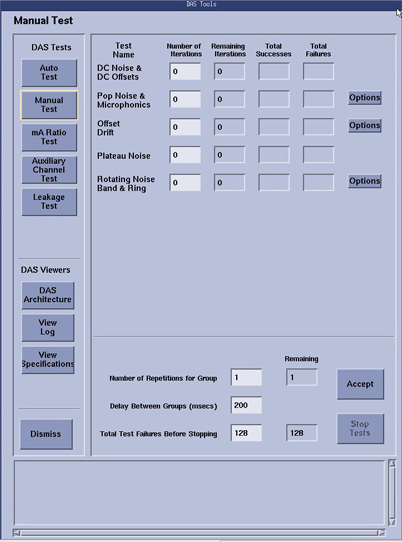
The Manual Test contains all the DAS Tools tests, with some flexibility. The operator can choose to enter a number of iterations for a sub-test, and can change some sub-test conditions through an option button menu.
There is no difference in data processing and specification for a sub-test launched from Auto Test of Manual Test. The Manual Test offers more sub-tests and more flexibility for troubleshooting purposes.
Depending on the system configuration and software release, the Auto Test and the list of sub-tests in the Manual Test may differ. Below is an example screen shot of an Auto Test/Manual Test start up window.
Figure 1. Auto Test
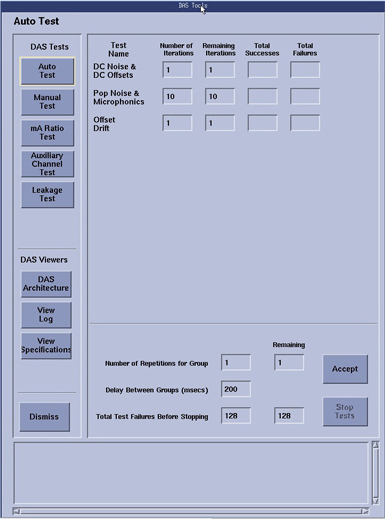
Figure 2. Manual Test
1 DC Noise & DC Offsets
-
Noise single: This test looks at the standard deviation by channels of non-offset corrected views.
A failure of this test will show up as a ring artifact.
-
Noise Module Average: This test looks at the average of noise for each 16-module channel.
A failure of this test will show up as a band artifact.
-
Offset: This test looks at the mean by channel of the non-offset corrected views.
note:The next two (2) items may or may not be available depending on system configuration/SW release.
-
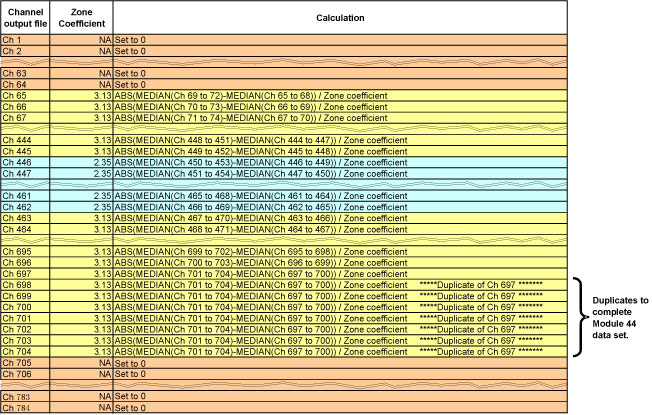
Structure Noise: This test looks at the difference between noise (rolling median) of four (4) consecutive channels to its neighboring four (4) consecutive channels normalized to the maximum allowable error (Zone Coefficient) of standard deviation of non-offset corrected views. For DoD Detector, structure noise is evaluated for the central channel zone only (channel 65 to 704).
The table below provides the calculation for each channel. This processing is applicable for each row.
The test output is: Matrix of 16 rows for 0.625 thickness and 8 rows for 1.25 thickness by 784channels. Channels 1 to 64 and 705 to 784 set at zero value for all rows. All other channels contain a calculated value in accordance with the table below.
Figure 3. Calculation
-
Electronic Noise: This test looks at the median of standard deviation of non-offset corrected view for channel 1 to 784ch.
2 Pop/Noise and Microphonics
A series of predefined rotating scans without x-ray, and the scan data saved on disk for analysis. The scan data is then view averaged and the standard deviations are measured against a spec limit.
This test takes a series of three scans. In the auto-mode, it takes ten iterations of the series. Failure analysis of this test is dependent on test results. Pop/Noise and microphonics issues can be caused by many system related conditions. Some of the most common could be the DAS/Detector interface (such as elastomer connection caused by dirt, oil, debris), flex top cover clamp torque incorrect, air plenum not installed, fan orientation not correct, power supply noise, electrical connections, gantry rotation/mechanical issues, and external influences.
It is highly important to look at patterns relative to DAS/Detector architecture, gantry rotation (azimuth position as well as velocity), and high voltage (with or without x-ray, rotor on/off).
3 Offset Drift
A series of data collection scans, over a course of 120 seconds, and the offset means values are analyzed to measure the amount of variance over 120 seconds of scanning. There are three scans taken in a 16 x 0.625mm + 8 x 1.25mm mode with a delay of 60 seconds between each scan. The absolute value of the Means are taken and compared. Scan time is 1.0 seconds @ 984 views/sec.
There should be little or no drift between the first scan of each scan mode and the scan taken 120 seconds later. The spec is ±3 counts for each channel across a 120 seconds time.
Therefore, from Table 3 above, the difference in counts between scans 1 and 3 must be within 2 counts per channel. Failure analysis of the drift test may be a bad converter board, but also considerations need to be taken on account of room temperature fluctuations and DAS warm-up time. It may be normal for this test to fail if it is executed immediately after turning on the DAS.
4 Plateau Noise
This test looks at the noise profile of nine (9) consecutive channels (rolling median) folded in quadrature around ISO.
A failure of this test will show up as a band artifact.
Plateau Noise test has been designed as a detector-level test, not a system-level test. Due to the folding of the data around ISO, the correlation of reported failure to physical detector channel is very difficult to achieve. DO NOT use this test for troubleshooting unless specifically directed to by engineering support.
5 Rotating Noise Band & Ring
Standard deviation of non-offset corrected views.