- Topic ID: id_11038913
- Version: 3.0
- Date: Jun 10, 2020 2:23:18 AM
xw8600 Host PC BIOS Setup
Prerequisites
The BIOS of the computer is a collection of machine language programs stored as firmware in ROM. The BIOS ROM includes such functions as POST, PCI device initialization, Plug 'n Play support, power management activities, and the BIOS Setup (F10) Utility. The BIOS Setup (F10) Utility enables you to change factory default settings and set or change the system configuration based on the Host PC hardware or system functionality requirements.
The BIOS Flash Code for programming the Host PC BIOS ROM is available on CD-ROM media (see Preliminary Requirements). In addition, the BIOS Flash Code is available from HP in the form of a downloadable CD image (ISO) file, which is used to create the above-mentioned BIOS CD.
1 HP xw8600 BIOS Flashing and Recovery
The following information covers the necessary procedures for flashing and recovering from corrupted or incomplete flashing of the Host PC’s BIOS ROM. This is not to be confused with the BIOS Settings discussed later. The BIOS firmware code flashed to the BIOS ROM is the executable portion of the BIOS ROM code, which includes a default set of configuration settings. Later, customize these settings for the Host PC’s specific configuration details. You can save and restore these customized settings on floppy drive media for quick restoration in the event of BIOS ROM corruption or BIOS updating.
1.1 xw8600 BIOS ROM Flash Update Procedure
Procedure
- If there is a diskette in the diskette drive, or a CD in the CD drive, remove the diskette or CD, and power down the Host PC.
- Insert the BIOS CD into the CD drive.
- Power on the Host PC.
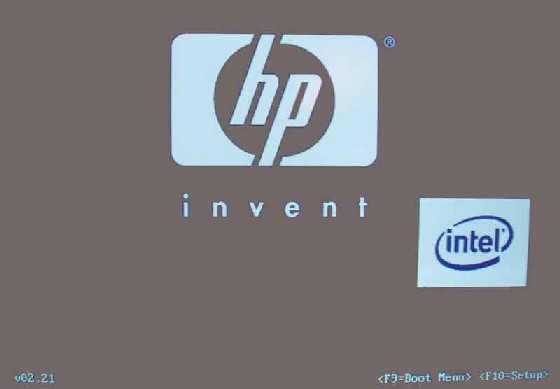
- Press F10 as soon as your display is active
and the word Setup appears in the lower right
corner of the screen. (See Figure 1.)
Figure 1. BIOS Splash Screen
 note: If you do not press F10 at the appropriate time, you must try again. Restart the Host PC and press F10 again to access the utility, or press Ctrl+Alt+Delete prior to boot if you miss the opportunity to press F10.
 - Select your language from the list (Figure 2) and press Enter.
- Use the left and right arrow keys to select the language option,
then press Enter.
Figure 2. BIOS Setup Language Selection Screen

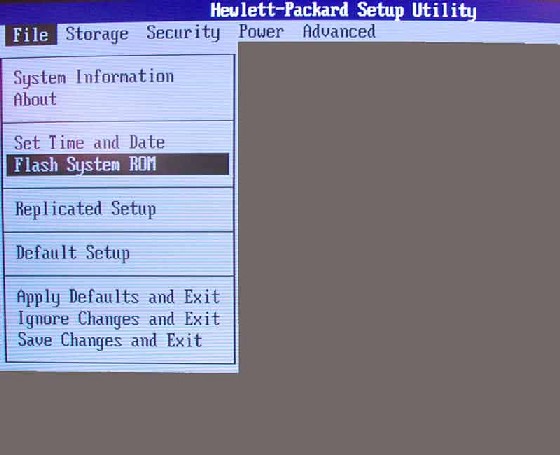
- In the BIOS Setup (F10) Utility menu, five headings are displayed: File, Storage, Security, Power, and Advanced. Use the left and right arrow keys to select the appropriate heading, then press Enter.
- Select File > Flash System ROM. (See Figure 3.)
Figure 3. Flash System BIOS ROM Selection
- Select the Optical Disk option and follow instructions on the screen to flash BIOS ROM.
- Remove the BIOS CD.
- On the File submenu, select File >Save Changes and Exit to reboot the Host PC.
1.2 xw8600 BIOS Recovery Procedure
The FailSafe Boot Block ROM allows for system recovery in the unlikely event of a ROM flash failure; for example, if a power failure occurs during a ROM upgrade. The Boot Block is a flash-protected section of the ROM that checks for a valid system ROM flash when the system is powered on, with the following results:
-
If the system ROM is valid, the system starts normally.
-
If the system ROM fails the validation check, the FailSafe Boot Block ROM provides enough support to start the system recovery from a BIOS CD.
When the Boot Block detects an invalid system ROM, the System Power LED blinks red eight times (once every second), followed by a two-second pause. You also hear eight beeps that correspond to the blinks. In some models, a Boot Block recovery mode message is displayed on the screen. To recover the system after it enters Boot Block recovery mode:
Procedure
- If there is a diskette in the diskette drive or a CD in the CD drive, remove the diskette or CD, and power down the Host PC.
- Insert the BIOS CD into the CD drive.
- Power on the Host PC.note: If no BIOS CD is found, you are prompted to insert one and restart the Host PC. If the system successfully starts and successfully reprograms the ROM, then the three keyboard lights illuminate. A rising tone series of beeps also signals successful completion.
- Remove the BIOS CD and restart the system.
2 xw8600 BIOS Setup (F10) Utility Procedure
The BIOS Setup (F10) Utility enables you to do the following:
-
Change factory default settings and set or change the system configuration, which might be necessary when you add or remove hardware.
-
Determine if all of the devices installed on the workstation are recognized by the system and functioning properly.
-
Determine information about the operating environment of the workstation.
-
Solve system configuration errors detected but not automatically fixed during the Power-On Self-Test (POST).
-
Establish and manage energy-saving time-outs (not supported for Linux platforms).
-
Modify or restore factory default settings.
-
Set the system date and time.
-
Set, view, change, or verify the system configuration, including settings for processor, graphics, memory, audio, storage, communications, and input devices.
-
Modify the boot order of installed mass storage devices, such as SATA, IDE (ATA), SAS, SCSI, diskette drives, optical drives, network drives, and LS-120 drives.
-
Configure the boot priority of SATA, IDE (ATA), and SAS hard drive controllers.
-
Select POST Messages Enabled or Disabled to change the display status of POST messages. POST Messages Disabled suppresses most POST messages, such as memory count, product name, and other non-error text messages. If a POST error occurs, the error is displayed regardless of the mode selected. To manually switch to POST Messages Enabled during POST, press any key (except F1 through F12).
-
Secure the integrated I/O functionality, including the serial, USB, or parallel ports, audio, or embedded NIC, so that the I/O functionality cannot be used until they are unsecured.
-
Enable or disable removable media boot ability.
-
Enable or disable removable media write ability (when supported by hardware).
-
Replicate your system setup by saving system configuration information on diskette and restoring it on one or more workstations.
Procedure
- Power on or restart the Host PC.
- Press F10 as soon as your display is active
and the word Setup appears in the lower right
corner of the screen.note: If you do not press F10 at the appropriate time, you must restart the Host PC and try again. Alternatively, you can press Ctrl+Alt+Delete prior to boot if you miss the opportunity to press F10.
- Select your language from the list, and press Enter. In the BIOS Setup (F10) Utility menu, five headings are displayed: File, Storage, Security, Power, and Advanced.
- Use the left and right arrow keys to select the appropriate heading. Use the up and down arrow keys to select the option you want, and press Enter.
- To apply and save changes, select File > Save Changes and Exit. Host PC will reboot.
- Remove floppy diskette.note: If you made changes that you do not want applied, select File > Ignore Changes and Exit.
To reset to factory settings:
-
Select File > Default setup > Restore Factory Settings as Default
-
Press F10 to accept the changes.
-
Select Apply Defaults and Exit. This option restores the original factory system defaults.
-
You can only open the BIOS Setup (F10) Utility by powering on the Host PC or restarting the system.
To access the BIOS Setup (F10) Utility menu, perform the following steps:
3 xw8600 BIOS Settings Save and Restore Procedures
Perform the following procedures to save the Host PC’s BIOS Settings (after proper configuration is set).
3.1 Saving BIOS Settings Using Floppy Drive
Procedure
- Reboot the Host PC, and press and hold F10 until you enter the Computer Setup (F10) Utility.
- Insert a formatted floppy diskette.
- Select File > Replicated Setup > Save to Removable Media and follow the instructions on the screen to create the BIOS Settings floppy diskette.
- Select File > Ignore Changes and Exit. The Host PC reboots.
- Remove the floppy diskette.
- Label the diskette “xw8600 BIOS Configuration Settings.”
3.2 Restoring BIOS Settings Using Floppy Drive
Procedure
- Reboot the Host PC, and press and hold F10 until you enter the Computer Setup (F10) Utility.
- Insert saved BIOS Settings floppy diskette.
- Click File > Replicated Setup > Restore from Removable Media and follow the instructions on the screen to restore the BIOS Settings from the floppy diskette.
- To apply and save changes, select File > Save Changes and Exit. The Host PC reboots.
- Remove the floppy diskette.
4 Saving and Restoring BIOS Settings as Default
This section describes the steps necessary to save and restore xw8600 BIOS Settings (Table 5).
4.1 Saving Host PC BIOS Settings as Default
Perform the following steps to save the Host PC BIOS Settings as default settings (settings currently configured and stored in ROM):
Procedure
- Reboot the Host PC, and press and hold F10 until you enter the Computer Setup (F10) Utility.
- Select File > Default Setup > Save Current Settings as Default. Follow the instructions on the screen to create the new Default BIOS Settings.
- To apply and save changes, select File > Save Changes and Exit. The Host PC reboots.
4.2 Restoring Host PC BIOS Settings from Default
Perform the following steps to restore the Host PC BIOS settings from default settings (BIOS Settings currently saved in Defaults Settings of ROM):
Procedure
- Reboot the Host PC, and press and hold F10 until you enter the Computer Setup (F10) Utility.
- Select File > Apply Defaults and Exit. Follow the instructions on the screen to apply default BIOS Settings. The Host PC reboots.
4.3 Restoring Host PC BIOS Factory Settings as Default
Perform the following steps to restore the Host PC BIOS factory settings (stored in ROM) as default settings:
Procedure
- Reboot the Host PC, and press and hold F10 until you enter the Computer Setup (F10) Utility.
- Select File > Default Setup > Restore Factory Settings as Default. Follow the instructions on the screen to apply factory default BIOS settings.
- To apply and save changes, select File > Save Changes and Exit. The Host PC reboots.note: Restore BIOS settings per Table 5.
5 xw8600 BIOS Settings Clear / Reset Procedure
Although rare, the BIOS Settings portion of the Host PC’s BIOS can corrupt, causing Host PC boot issues and POST errors. In the event that you suspect the BIOS Settings is corrupted, perform the following steps to clear/reset the setting to the HP factory default values.
Procedure
- Shut down the operating system, and power off the Host PC and any external devices.
- Disconnect the power cord of the Host PC and any external devices from the power outlets.
- Disconnect the keyboard, monitor, and any other external devices that are connected to the workstation.
- Remove the access panel.note: Pushing the CMOS (BIOS Settings) button resets CMOS values to HP factory defaults and erases any customized information, including passwords, asset numbers, and special settings. It is important to back up the Host PC BIOS settings (Table 5) before resetting them in case they are needed later. It is also important to back up the Host PC’s BIOS Setting before BIOS corruption occurs, otherwise you need to configure the BIOS setting manually.
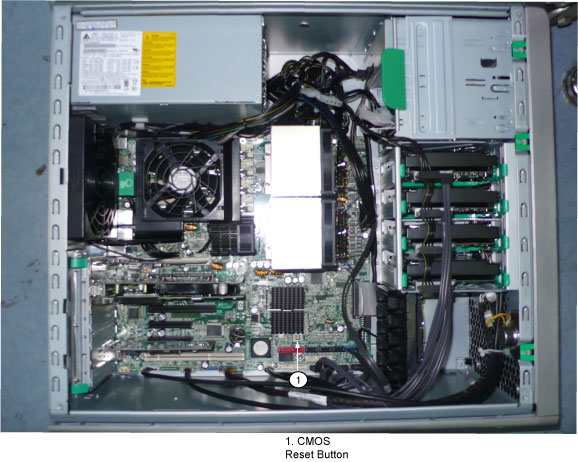
- Locate, press, and hold the CMOS button (Figure 4) in for five
seconds.note: Be sure that the AC power cord is disconnected from the power outlet. The CMOS button does not clear CMOS if the power cord is connected.
Figure 4. BIOS Setting (CMOS) Reset Button
- Replace the access panel.
- Reconnect any external devices.
- Plug in and power on the Host PC.note: The workstation passwords, and any special configurations, along with the system date and time, must be reset.
- Restore the saved BIOS Setting from the locally-created BIOS Setting Floppy, or manually configure the BIOS settings.
- To apply and save changes, select File > Save Changes and Exit. The Host PC reboots.