- Topic ID: id_16157915
- Version: 1.0
- Date: Jul 7, 2018 4:27:36 PM
Scan Data Analysis Tools (SCAN, Tracking dd, CAL)
This module contains the following information:
-
Overview - Overview
-
Definitions within Scan Analysis - Definitions within Scan Analysis
-
Starting Scan Analysis - Starting Scan Analysis
-
Selections in Scan Analysis - Selections in Scan Analysis
-
dd File List Select Overview - dd File List Select Overview
-
Z-Axis Tracking - Z-Axis Tracking
-
Tube Spit Data Correlation Example - Tube Spit Data Correlation Example
-
Typical Examples of CAL Plots with Scan Analysis - Typical Examples of CAL Plots with Scan Analysis
1 Overview
The scan analysis feature allows users to have interactive access to scan files collected on the scanner. Scan data to be viewed can come from either patient scanning or from service mode tools such as Diagnostic Data Collection or Calibration.
Analysis is divided into three major areas of: SCAN ANALYSIS, dd FILE ANALYSIS, and CAL FILE ANALYSIS. CAL File analysis is not yet available for this system. Each major section provides a file list select interface similar to the Image Works List Select, Image Browser. Analysis List Select allows you to select the appropriate file of interest.
Any of the normal scan files may be selected for processing within Scan Analysis including Axial, Helical, and Scout scans. Once the scan data of interest is selected you can select one of several processing options, which include: Update, Scan Header, Cal Vectors, Aux Channels, Create MSD dd File, Plot MSD, Plot VVC, and Save Scan.
2 Definitions within Scan Analysis
dd File (Diagnostic Data File): dd files are a result file from some type of operation on the scan data file. dd files are typically some form of view summed file that may have had some specific type of processing applied to it. For example, the processing applied to the raw data to calculate the position of the pin in ISO alignment results in a temporary file that is a view summed result that could be saved as a dd file. As long as two dd files have the same number of data elements in them, the two files may be added, subtracted, multiplied, or divided with each other.
Detector Macro Row: One detector output row for each of the four 4x1.25, 4x2.5, 4x3.75, or 4x5 acquisition mode combinations for the detector. For most of the analysis functions, this provides either four selections for the detector row to be examined, or four sets of data results that correspond to the detector rows 2A, 1A, 1B, 2B. Refer to Watson16 Detector Theory for further information.
Means and Standard Deviation File (MSD): This is usually the result of combining two or more views mathematically, which results in mean values for each channel in the views and an associated standard deviation for each channel in the views. In essence all of the user selected views in a scan file are summed together, resulting in a single “master view” that contains the averaged data from all of the views. The mean values represent the average data value from the channels, and the standard deviation values represent the amount of variability for that channel’s data values across all of the views. The higher the standard deviation, the more the channel output varied from view to view.
Scan Header: This is the information contained within the scan file that identifies the specific settings in effect when that scan file was created. The scan header includes information at several levels, including: Exam, Series, and Scan. Information identifying the technique selections, scan time, acquisition mode, and many others may be found in the scan header.
Cal Vectors: Within scan analysis, the cal vectors are only those vectors contained within the scan data file at the time that the scan was taken.
Aux Channels: The auxiliary channels are data sampling “channels” in the MDAS that provide a way to place other data into the view besides the patient information coming from the detector. These include: Power Supply, Temperature, kV, mA, and other analog data values. These analog signals are sampled at the same rate as the patient image data and are a snapshot of those values at each view sample time.
Z-Axis Channels: These are some special purpose channels built into the detector that are used for several different special operations related to determining the x-ray beam position on the detector.
VVC (Views vs. Channels): This is a way to graphically represent the data values from each channel for each view of data from the MDAS as a shade of grey. The display has the views stacked vertically and the channels arranged across the display horizontally.
3 Starting Scan Analysis
Scan Analysis may be started from any of several menu locations, including: UTILITIES, TOOLS and IMAGE QUALITY.
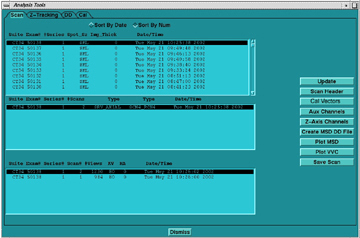
Figure 1. Initial Scan Analysis Screen
4 Selections in Scan Analysis
Upon starting the Scan List Select window, you can highlight an , and perform the desired analysis feature by pressing any of the following buttons:
4.1 UPDATE
The UPDATE selection will refresh the List Select display if new scan files have been created since the Scan Analysis Tool was started.
4.2 SCAN HEADER
The SCAN HEADER selection will open a scrolling text window that contains the header text information contained in select scan file.
4.3 CAL VECTORS
The CAL VETORS selection will open a window allowing you to select the calibration vectors in the selected scan file that you wish to view. After the selections are made, OK will process the data requests and display the results.
The resultant plots are auto-scaled, and in some cases, the range of data displayed is automatically set. This is to provide a reasonable initial view of the data. Always check the scale on the left-hand side of the plot displays. Cursor reporting of data value and channel numbers is provided.
The default selections are underlined in Table 1.
4.4 AUX CHANNELS
This selection will open a window that allows you to select which of the auxiliary channels in the scan file you wish to look at, as well as the start and ending views to display. After the selections are made, OK will process the data requests and display the results.
The resultant plots auto-scale, and in some cases the range of data displayed is automatically set. This is to provide a reasonable initial view of the data. Always check the scale on the left-hand side of the plot displays. Cursor reporting of data value and view numbers is provided.
The default selections are underlined in Table 2.
4.5 Z AXIS CHANNELS
This selection allows you to select the start and end views to display for the Z Axis Channel data. After the selections are made, OK will process the data and display the results.
4.6 CREATE MSD DD FILE
This will calculate a view averaged “super view” for the selected views and store the results in a separate file on the systems disk. The display will report the path and filename of the file just created. Once created, dd File can be viewed or compared with other files to check for specific operating characteristics.
4.7 PLOT MSD
Provides a set of view summed means and standard deviation plots of a scan file. The plotter is started to display the means vectors and the standard deviation vectors, computed across the entire scan for each detector macro row. Four mean and standard deviation plot sets displaying the window.
After Plot MSD is started, a window will allow you to select:
-
Start View and EndView
-
View Compression: Automatic, 2 to 1, 4 to 1
-
Processing steps:
-
Offset Correction: This processing step removes the signal bias introduced by the acquisition electronics from the scan data. This operation is performed on a channel-by-channel basis for each view.
-
Primary Speed Correction (afterglow): This processing applies a correction value to each channel value to reduce the effect of scintillator afterglow from the detector cells.
-
Reference Normalization: Makes use of unobstructed (not blocked by the patient) detector cells at the end of the detector to adjust for fluctuations in the x-ray beam and effects of aperture size and mA. In the case where the reference channels are blocked, the system uses an estimated value for the processing. The steps for reference normalizing the scan data involve:
-
Offset correction for the reference channels.
-
Dividing the offset corrected scan data by the averaged reference channels for each view.
-
-
Convolved Data: This processing step mathematically filters the channel data to remove blurring effects that would occur when the views are back-projected. The effect is to “sharpen” each channel’s data value within the view. Without the convolution step, some of the x-ray attenuation data for a particular channel ends up in the channels on either side of that particular channel. Convolution puts that adjacent channel contribution back into the channel data that it should have been in to begin with.
-
Cursor reporting of data value and channel numbers is provided.
4.8 PLOT VVC
4.8.1 Description
The PLOT VVC selection provides Views-vs-Channels display of a grey scale representation for the selected scan file. Each view of data (or summed, compressed view) is represented on the display as a horizontal line. Each pixel in the line represents the data value for a particular channel from the DAS.
After VVC is activated, a window will allow you to select:
-
Row (macro row) One of: 2A, 1A, 1B, 2B
-
Start View and EndView
-
Start Channel and End Channel
-
View Compression: Automatic, 2 to 1, 4 to 1
-
Processing steps:
-
Offset Correction: This processing step removes from the scan data, the signal bias introduced by the acquisition electronics. This operation is performed on a channel-by-channel basis for each view.
-
Primary Speed Correction (afterglow): This processing applies a correction value to each channel value to reduce the effect of scintillator afterglow from the detector cells.
-
Reference Normalization: Makes use of unobstructed (not blocked by the patient) detector cells at the end of the detector to adjust for fluctuations in the x-ray beam and effects of aperture size and mA. In the case where the reference channels are blocked, the system uses an estimated value for the processing. The steps for reference normalizing the scan data involve:
-
Offset correction for the reference channels.
-
Dividing the offset corrected scan data by the averaged reference channels for each view.
-
-
Convolved Data: This processing step mathematically filters the channel data to remove blurring effects that would occur when the views are back-projected. The effect is to “sharpen” each channel’s data value within the view. Without the convolution step, some of the x-ray attenuation data for a particular channel ends up in the channels on either side of that particular channel. Convolution puts that adjacent channel contribution back into the channel data that it should have been in to begin with.
-
Once displayed, the window and level for the displayed data can be changed to better see variations in the data.
4.8.2 Cursor Behavior in VVC
Cross hair cursor reporting is provided for: Data Value, DAS Channel, Detector Channel, and View number. The cursor is moved across the display using the mouse.
A selection box on the display allows selection of line cursors and box cursors, which allow the selection of a channel, view, or group of channels and views for plotting.
The line and box cursors can be moved around the screen to view specific areas of interest. When the mouse pointer cursor is moved over a line cursor the mouse cursor will change to a four pointer arrow. Pressing the left mouse button allows you to ’drag’ the cursor across the display.
For the box cursors, the box may be dragged using the left mouse button with the mouse cursor positioned over the box. The size and shape of the box can be changed by moving the mouse cursor over the Bottom or Right edges of the box. When over the Bottom or Right edges of the box you can press the left mouse button to drag the box edge up and down or left and right.
With the channel and view cursors, the plotted data represent all channels for a selected view or all views for a selected channel.
With the box cursors, the resulting plot is a view summed means and standard deviation plot for the selected views and channels.
4.9 SAVE SCAN
This will save the selected scan file to a temporary disk location so that it can moved to MOD or transferred via ftp to another location.
5 dd File List Select Overview
dd math is a means for the user to apply mathematical operations: add, subtract, multiply, and divide to dd files, and calculate the channel-to-channel difference or ratio of means vs. standard deviation vectors of a dd file. It allows the user to specify the scaling factor for the output vector, and provides three output modes: dd file, plot, and view numbers.
dd math is part of the dd analysis user interface. Scan Analysis is used to generate dd files that may then be manipulated or examined using dd File Analysis.
5.1 dd Files Generation
There are 18 different dd file types of six orientations. The orientations are View, Channel, RTS, CAL, Elements, and Header.
Channel oriented means and standard deviation type dd files are the only type that can be created from scan data files in the Scan Analysis application.
5.2 dd Math Functions
dd math consists of the following functions:
-
Add
-
Subtract
-
Multiply
-
Divide
-
Channel to Channel difference
-
Ratio of means vs. standard deviation
5.3 Add, Subtract, Multiply, Divide
Applies add, subtract, multiply, and divide between vectors in two dd files. The output file is a dd file with one of the following suffixes:
-
.add
-
.dif
-
.mul
-
.rat
Operations can be performed on dd files in View orientation, Channel orientation, RTS orientation, and Cal orientation.
Currently, no dd type restrictions are applied to operations between dd files, as long as the dd vectors have the same number of elements. If one file has a single vector and the other file has multiple vectors, the mathematical operation is applied multiple times using the single vector. Otherwise, the mathematical operation is applied component-wise for the number of vectors in each file.
5.4 Channel to Channel Difference
Applies the following calculation to the data from the data set(s) in the dd files for View, RTS or Cal orientation:
(X2-X1), (X3-X2), (X4-X3),...,(Xn-Xn-1)
where X is the data value for each channel.
The output is channel to channel dd file with extension: .c2c
5.5 Ratio of Means vs. Standard Deviation
Takes a MSD (means and standard deviation) or RTS (real time statistics) type of dd file, calculates the ratio of data in the means vector (1st set) to data in standard deviation vector (2nd set). The output file is a ratio type of dd file with the extension: .rat
5.6 dd Math Output Mode
Three output modes are supported in dd math:
-
Plot - Will plot the output dd vector using an on-screen vector display.
-
dd File - Allows the user to specify the output dd file name with a full path or the file basename. If only base name is provided, the program will use the default prefix and suffix for the output file. The created dd file appears in the dd file list.
-
View Numbers - View Numbers will display the dd vector numerical values on the screen, and the user can perform numerical searches in the window.
5.7 dd Analysis User Interfaces
The dd math operation panel and a set of the dd math operation buttons are part of the ddLS screen.
5.8 Functions in ddLS User Interface
The ddLS supports the following functions for various file types.
-
Update
-
Plot
-
Save to MOD
-
Restore From MOD
-
dd math operations: +, -, x, /, ch2ch, Ratio
-
Sort By Date or Sort by Type
The user can perform these functions, except dd math operations, by simply selecting one or more files in the list select window, and clicking the function button. The following file types are supported in the ddLS user interface.
-
dd File
-
Cal File
-
Data File
5.9 File Operations
-
dd Math Operations - Perform: add, subtract, multiply, divide, and channel to channel difference operations on dd files. These operations are only available for dd file types.
-
Plot - Plots the vector(s) of the selected files in the display window for the following file types: dd Files and Cal Files
-
View # - Prints the numerical data of the dd vector(s) to the display window(s). For image file types and scan file types, it displays the VVC plots of the selected files.
-
Save/Restore to/from MOD - Saves the selected files to the MOD and restores all the dd files from /MOD/ddfiles to /data directory.
-
Update - Refreshes the display in the ddLS user interface.
5.10 dd Math Operations in ddLS
The dd math operation buttons become insensitive if no files are selected in the dd math operation panel.
The user may start dd math operation(s) by selecting the file(s) and putting them into the selection field by clicking the button FILE #1 or FILE #2. If the selected file is not a dd file, the application will not put it into the dd math operation field. A message window will pop up and ask user to select a dd file.
If only one file is selected and it is of the file type RTS dd file or MSD dd file, both CHANNEL TO CHANNEL and RATIO OF MEANS VS. STDV become sensitive. If the selected file is not of the type MSD or RTS, only CHANNEL TO CHANNEL become sensitive. When two dd files are selected, ADD, SUBTRACT, MULTIPLY, and DIVIDE become sensitive and CHANNEL TO CHANNEL and RATIO OF MEANS VS. STDV become insensitive.
The user can specify the output file name when the dd file output mode is set. Otherwise the system offers a default dd file name.
The default output scaling factor is 1.0. The user can set the scaling factor to any real number.
When the dd math operation buttons are sensitive, the user can select the desired button to start the dd math operation.
6 Z-Axis Tracking
The Z-AXIS TRACKING tool is a new TAB, located within the Analysis Tool. The tool can be used to plot various tracking functions, using a Scan Data Set. For a scan data set, the analysis package can plot different data versus views in UN-FILTERED (the default) or FILTERED (20 pt. Boxcar) formats. Numerical information (“Max”, “Min”, “Mean”, and “Std. Dev.”) is also provided. In some plots, the numerical information provided can be used for further analysis by comparing it to a “specification” value, as an indication of a pass/fail condition. Whereas other plots are more general, and in some cases may be useful, they are typically only used for troubleshooting.
Figure 2. Top Level Tracking Menu
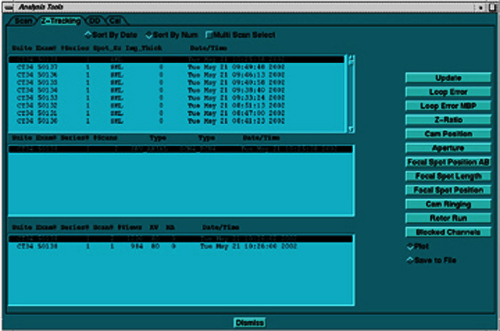
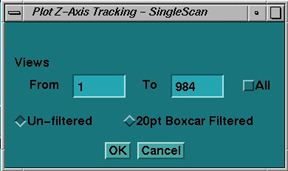
In the figures that follow, examples of “known” tracking plots are shown. Since plots vary from system to system, the examples shown should be used only as guides. Compare your system’s plots and analyze them relative to the specification shown in each figure. The plots shown are UN-FILTERED views, which is the default option when they are plotted. A 20 point boxcar filter takes the 20 view average and then plots the data.
Figure 3. Single Scan Pop-Up Menu
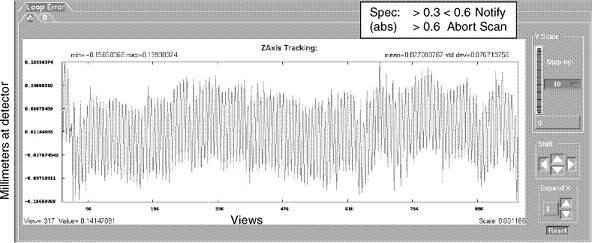
A value is not considered to be out of specification unless the limit is exceeded for a sustained interval of 100 views or more. In the cases where specifications are not given, consider plots informational only.
6.1 LOOP ERROR
A LOOP ERROR is the difference between the calculated position of the beam minus the desired target’s position (operating point) obtained during Collimator Calibration.
Figure 4. Loop Error Plot
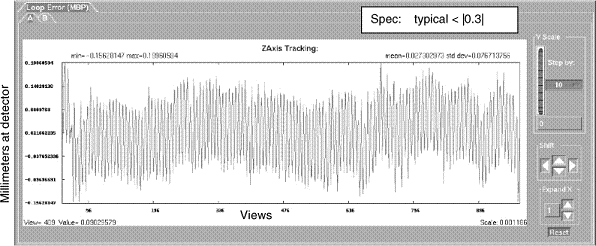
6.2 LOOP ERROR (MBP)
A LOOP ERROR MBP (Mean Beam Position) plot is the same as the loop error plot, except that the display represents the loop error relative to the mean beam position during FASTCAL. The FASTCAL beam position is stored in the calibration database.
Figure 5. Loop Error (MBP) Plot
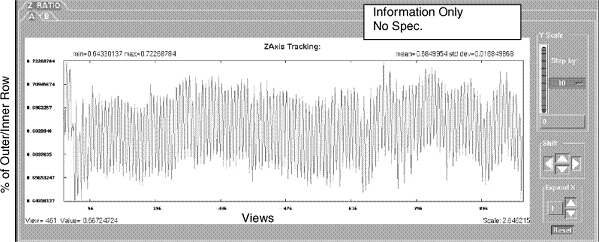
6.3 Z RATIO
Z-RATIO Plot computes the ratio of outer row Z-channels (Channels 763, 764, & 765 averaged) to inner row Z-channels. This is done for both the “A” and “B” sides.
Figure 6. Z Ratio Plot
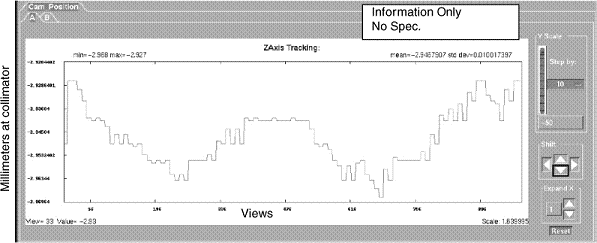
6.4 CAM POSITION
The CAM POSITION plot shows the CAM position during a scan from collimator opening (center-line). The absolute value of A side plus B side is the total aperture size at the collimator. Cam positions are stored in the scan file.
Figure 7. CAM Position Plot
6.5 APERTURE
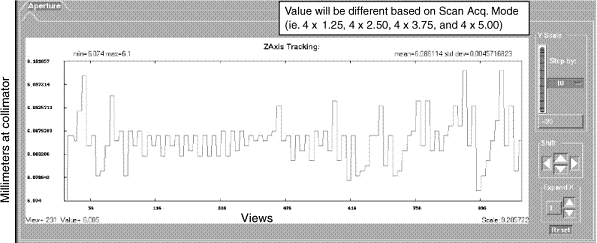
APERTURE plot indicates the width of the Collimator Cam aperture in millimeters. Due to the distance magnification factor, the width at the collimator is smaller than prescribed acquisition mode, or width of the beam at the detector window.
Figure 8. Aperture Plot
6.6 FOCAL SPOT POSITION (A/B)
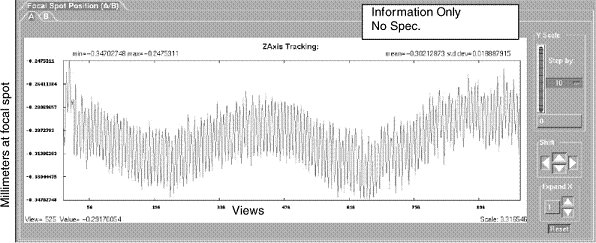
FOCAL SPOT POSITION plot shows the calculated focal spot position from the centerline of either the A or B side. The vertical scale (in millimeter) represents that portion of the focal spot length. The absolute value of the A side plus the B side should equal the focal spot length (Small Spot = 0.7mm, Large Spot = 1.2mm).
Figure 9. Focal Spot Position (A/B) Plot
6.7 FOCAL SPOT LENGTH
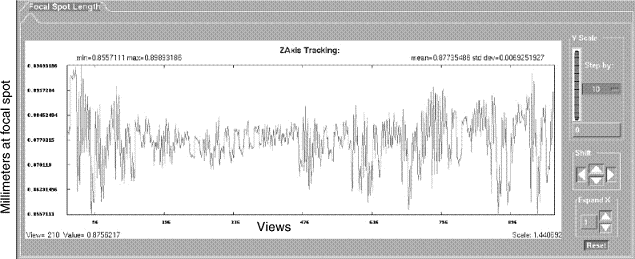
FOCAL SPOT LENGTH plot shows the calculated focal spot length. The length may change slightly due to mA, rotor wobble or gantry rotation wobble. Length is also based on the calculations, which use values from the Z-channels. Typically the small spot size is 0.7mm, and the large spot size is 1.2mm.
Figure 10. Focal Spot Length Plot
6.8 FOCAL SPOT POSITION
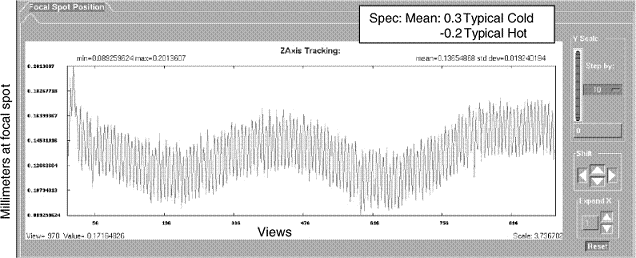
FOCAL SPOT POSITION plot indicates the calculated focal spot position relative to the centerline, with the center position being 0. The focal spot moves during a scan due to mA, rotor wobble, gantry rotation wobble, and because of tube (target) heat.
Figure 11. Focal Spot Position Plot
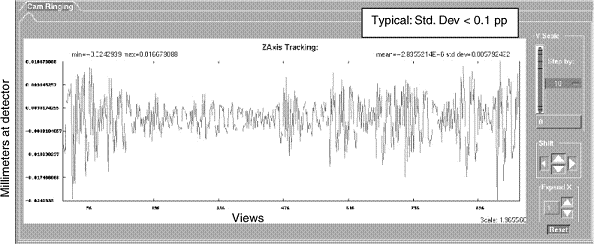
6.9 CAM RINGING
CAM RINGING provides a plot of high frequency variations, such as variations that are 180 degrees out of phase, like typical CAM ringing. A specification is not available, but typical values are less than 0.1 counts.
Figure 12. CAM Ringing Plot
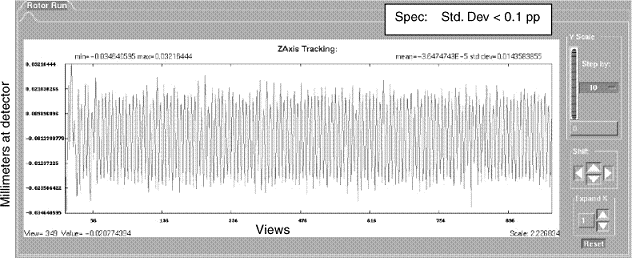
6.10 ROTOR RUN
Figure 0-1ROTOR RUN provides a plot of high frequency variations that are IN phase, such as the small periodic movement of the anode at the rotor run frequency. Typical values are less than 0.1 count values.
Figure 13. Rotor Run Plot
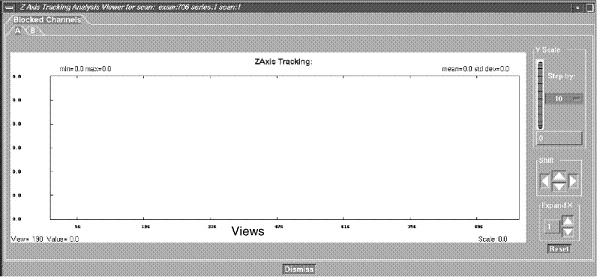
6.11 BLOCKED CHANNEL
A BLOCKED CHANNEL indicates that the value for DAS Channel 762 falls below the 10% threshold. Indicating that the channel is blocked and tracking (CAM positions) remains constant at the last known good position. This plot indicates a normal unblocked scan. Unblocked condition is indicated by a numeric value of 0. Blocked view condition is indicated by a numeric value of 1.
Figure 14. Blocked Channel Menu
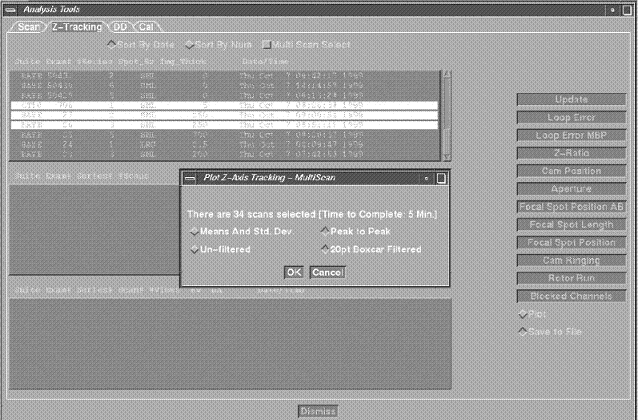
6.12 MULTI-SCAN SELECT
The MULTI-SCAN SELECT option allows the user to calculate and view multiple scans. Select the MULTI-SCAN SELECT button, and then select the exams, series, or multiple scans. Once scans are selected, then select the plot that you are interested in. Due to the time it may take, based on the number of scans selected, a pop-up window may appear, to indicate the number of scans selected and the approximate time to calculate. If the time is too long, or wrong scans are selected, hit CANCEL. Once the OK button is selected, you cannot cancel processing.
Figure 15. Multi-Scan Select Menu
7 Tube Spit Data Correlation Example
By using a combination of capabilities within Scan Analysis, some things just got easier.
In the past, tube spits as a source of image artifacts were frequently done by implication. The tube has been spitting lately, so the problem might be that.
With some of the new system and software capabilities, it is much easier to confirm some of these diagnosis. For example:
-
VVC data for scan (refer to Figure 16). Dark horizontal lines are views with data values lower than the views immediately before and after.
-
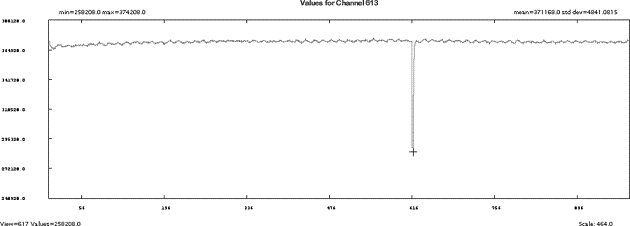
Select Channel Cursor and Plot Now (refer to Figure 17). Notice how the dip in the channel data corresponds to the views around 615. Next take a look at the kV and mA data.
Figure 16. VVC Tube Spit Data Example
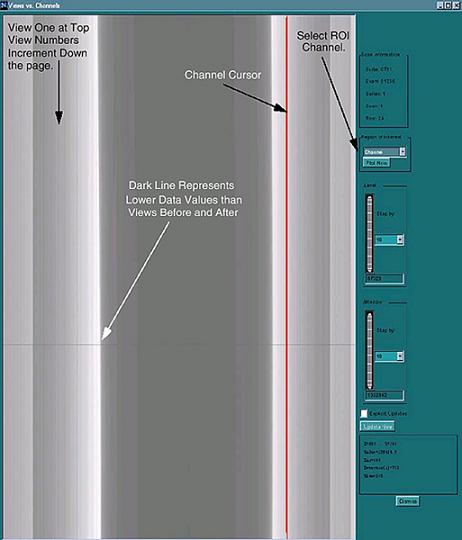
Figure 17. All View for one channel KV Spit Data Example
Once again the dip in the KV values reported in the view data corresponds to views around 615.
Figure 18. - Tube Spit Auxiliary Channel data for kV
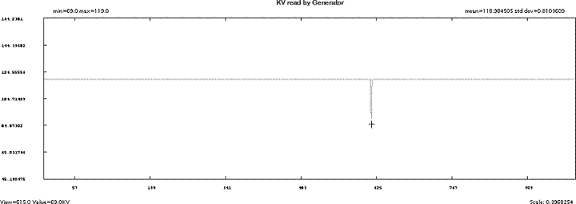
Figure 19. - Tube Spit Auxiliary Channel data for mA
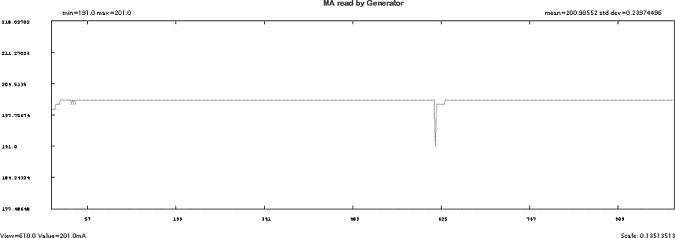
From the previous examples, it is easy to correlate the views with suspect data from the VVC Display with the view by view plots for kV, mA, and Channels. Specific information to look for on the examples:
-
The Min, Max, and average values for kV, mA, and channel data. This information provides a quick way to determine the scale of the information that you are viewing.
-
The cursor report information provides a continuous update, depending upon the type of data that is being displayed: data values, view number, channel number.
8 Typical Examples of CAL Plots with Scan Analysis
Figure 20. Calibration Vector Acal / Head Filter
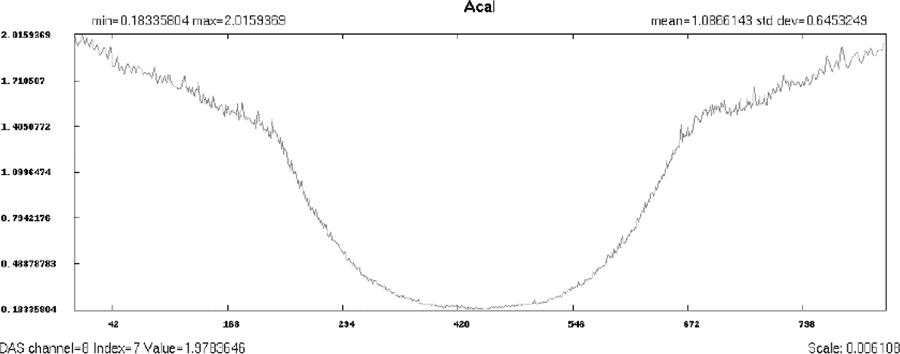
Figure 21. Calibration Vector Sin / Head Filter
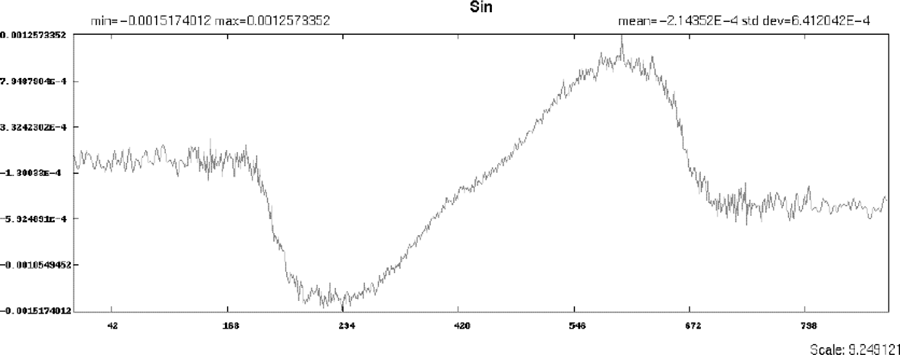
Figure 22. Calibration Vector Cosine / Head Filter
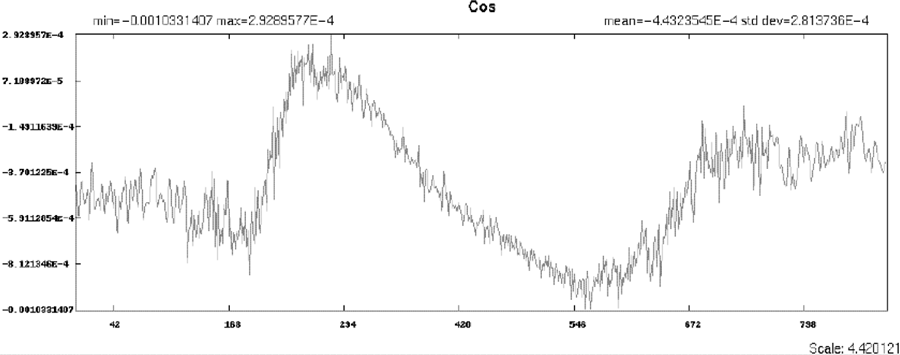
Figure 23. Calibration Vector “B1” / Head Filter
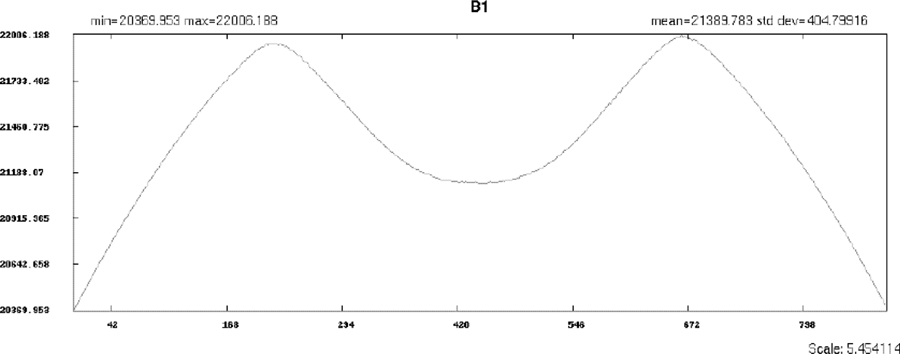
Figure 24. Calibration Vector “B2” / Head Filter
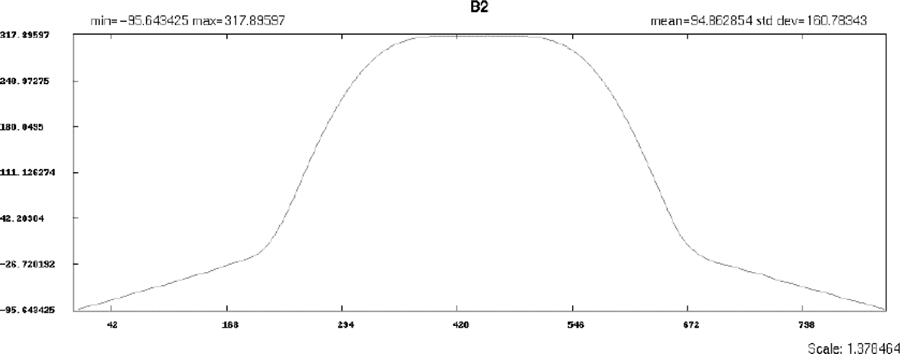
Figure 25. Calibration Vector “B3” / Head Filter
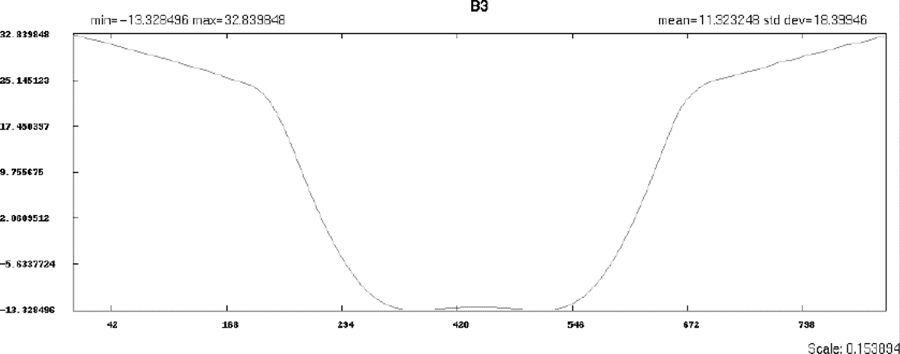
Figure 26. Scaled P-Cal - Head Filter
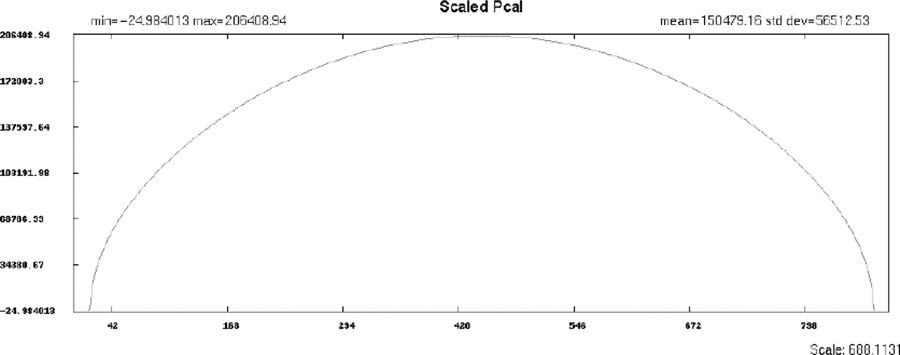
Figure 27. Matrix DeCon Kernels
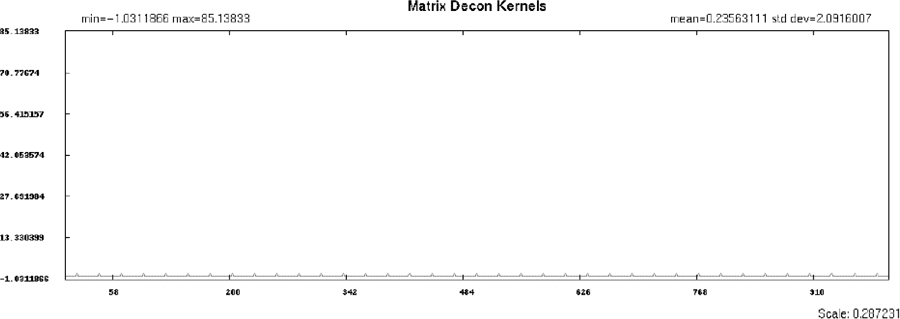
Figure 28. Z-Slope Cal / Ceiling Function
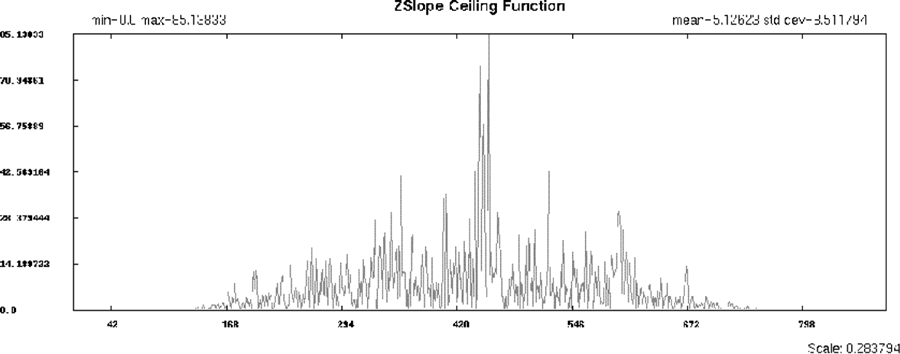
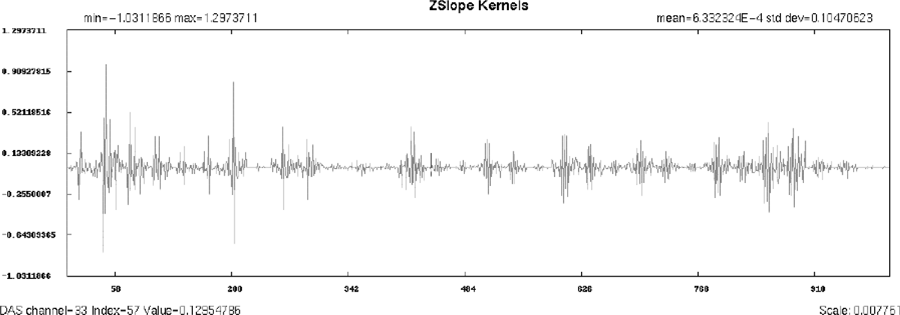
Figure 29. Z-Slope Cal / Z-Slope Kernels