- Topic ID: id_17423057
- Version: 4.0
- Date: Jan 20, 2020 8:34:53 PM
Hydraulic Tilt Motor Assembly Replacement
Prerequisites
Overview
1 Hydraulic Tilt Motor Assembly Removal
 |
|
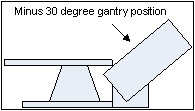
Spatial orientation defined in this section and for all procedures is from the perspective of an observer standing at the end of the patient table looking towards the Gantry Display board, through the gantry. This orientation defines a "Negative or minus "-") gantry position which places the top of the gantry leaning away from the observer. If necessary, refer to System Safety Overview for exact orientation.
Procedure
- Remove gantry side and any base covers to gain access to the gantry Tilt Hydraulic Assembly located in the base of the gantry.
- Proceed as follows:
-
(For gantry tilt function operational) Use the
one of the operator controls on the gantry cover to drive the gantry
to the minus 30-degree (all the way back) position. Refer to Figure 1 for a side
view and exact location of the gantry.note:
When you are standing at the back of the table facing the Gantry Display Board, looking through the gantry, the top of the gantry must be tilted away from you, (All the way back). Refer to Figure 1 for a side view and exact location of the gantry.
Figure 1. Service Orientation for Gantry Tilt
-
(For gantry tilt function NOT operational) Use
the service switch on the Gantry Control Board to drive the gantry
to the minus 30-degree (all the way back) position. Refer to Figure 1 for a side
view and exact location of the gantry.
On the Tilt Relay Board located on the Tilt Motor Control Board located in the gantry base near the Tilt motor:
-
Locate and place the Service Switch in the “Service” Position.
-
Use the Manual Tilt drive switch on the Tilt Relay Board to drive the gantry to the mechanical stops.
-
-
(For gantry tilt function operational) Use the
one of the operator controls on the gantry cover to drive the gantry
to the minus 30-degree (all the way back) position. Refer to Figure 1 for a side
view and exact location of the gantry.
- Stop the rotor of X-ray tube in case of Liquid Bearing Tube before HVDC off. Refer to Liquid Bearing Tube Rotor stop procedure for details.
- Once the gantry is in the correct position, disable the gantry tilt function, high voltage, and 120VAC service switches.
- Shutdown system software and turn off the console power switch under the console table top.
- Remove all system power at the main disconnect (A1) panel. Perform proper Lockout/Tagout power control procedures.
- While viewing the gantry from the rear, the gantry Tilt Hydraulic Assembly is located inside the right gantry base assembly of the gantry. Label the wires located on the gantry Tilt Relay Board for later assembly.
- While viewing the gantry from the rear, disconnect the three-phase power plug at the side of the gantry power pan, located inside the left side of the gantry base assembly.
- Remove the rear screws securing the gantry Tilt Hydraulic Assembly to the gantry base frame.
- Loosen the front screws securing the gantry Tilt Hydraulic Assembly. Their complete removal is not necessary.
- Disconnect and remove the cables connections and wires at the terminal on the Tilt Relay Board.
- Identify all tie wraps and fasteners securing the hydraulic lines to the gantry frame and Take note of the routing of these hydraulic lines.
- Remove any fasteners and tie wraps securing the hydraulic lines to the gantry base frame and hydraulic cylinder. Be careful not to puncture or kink any of the hydraulic lines
- While viewing the gantry from the rear, remove the MSUB or TGPU Assembly to gain access to the lower hydraulic cylinder mount bolts.
- While viewing the gantry from the rear, loosen 4 hex socket caps at the top of the left hydraulic cylinder mount bracket, and 3 screws of the mount bracket at the bottom of the left hydraulic cylinder. Keep your hands clear of potential gantry pinch points at all times.
- Remove the left hydraulic cylinder and its lines from the gantry base.
- Carefully install the new left hydraulic cylinder in place. Make sure the lines are properly routed along the gantry frame. Do not tie wrap them in place at this time.
- While viewing the gantry from the rear, loosen 4 hex socket caps at the top of the right hydraulic cylinder mount bracket, and 3 screws of the mount bracket at the bottom of the right hydraulic cylinder. Keep your hands clear of potential gantry pinch points at all times.
- Remove the right hydraulic cylinder and its lines from the gantry base.
- Completely remove the gantry Tilt Hydraulic Pump Assembly from the gantry base.
2 Hydraulic Tilt Motor Assembly Installation
Procedure
 danger
- To proceed, inspect the replacement gantry tilt hydraulic unit
and hydraulic cylinders for any damage in shipment. There should be
no leaking oil and no residual oil in the shipping crate. The hydraulic
pistons should be full compressed into their cylinders. (Do not extend
the pistons by hand.)
- If you suspect that the replacement unit is not in proper condition for installation or appears damaged in any way stop the replacement process and escalate by calling Field Leadership for further direction.
- If you do not see any damage remove the replacement unit from its shipping crate being careful not to kink the hydraulic lines.
- Move the replacement unit to the back of the gantry.
- Install the gantry Tilt Motor Assembly into the base. Secure the gantry Tilt Motor Assembly with its four screws.
- Install the right hydraulic cylinder.
- Loosely secure all hydraulic lines with tie wraps. Do not tighten the tie-wraps at this time. Make sure to leave approximately 1 inch (2.5cm) of slack on both left and right cylinder lines to prevent hose damage during forward tilt.
- Attach all wires and cables removed from the gantry Tilt Relay Board.
- While viewing the gantry from the rear, torque the M12 screws for the upper left cylinder mount bracket to 66.4 N-m (49 ft-lbs).
- While viewing the gantry from the rear, torque the M12 screws for the upper right cylinder bracket to 66.4 N-m (49 ft-lbs).
- Install the MSUB or TGPU Assembly to the gantry frame. If any tie wraps were removed from the cables, re-install new ones. Attach any cables removed.
- Remove Lockout/Tagout following all Lockout/Tagout procedures to restore main power.
- danger
- danger
- Enable the gantry tilt function, High voltage, and 120VAC service switches.
- Place the Service Switch in the “Service” Position.
- Make sure the Tilt Enable switch is enabled.
- Use the manual tilt switch to drive the gantry off of its stops approximately 1 inch (2.5cm).
- Set the Service Switch to the “Normal” position.
- Turn on the Console using the power switch under the console table top. The system software should automatically boot the system up to full operation.
-
(For 1 FE only) If another Field Engineer is
not present to aid in the initial movement of the gantry, proceed
as follows. When moving the gantry tilt for the first time periodically
stop titling the gantry and check the gantry movement for obstructions
and slack in the hydraulic lines.
- Stand at the side of the gantry (clear of tilt motion) and use one of the operators control panels on the front of the gantry to tilt the gantry forward using the tilt feature to tilt the gantry to the -20 degree position for first time and stop.
- Check the hydraulic lines to ensure that there is enough slack to accommodate further tilting.
- Stand at the side of the gantry (clear of tilt motion) and use one of the operators control panels on the front of the gantry to tilt the gantry forward using the tilt feature to tilt the gantry to the -10 degree position for first time and stop.
- Check the hydraulic lines to ensure that there is enough slack
to accommodate further tilting.note:
It may be possible for the gantry to move erratically when it passes through the zero degree (fully upright) position the first time and its weight becomes supported by the new hydraulic system.
- While staying clear of the gantry (stand at its side), use one of the operators control panels on the front of the gantry to continue tilting the gantry forward to the zero degree (Fully upright) position and stop.
- Check the hydraulic lines to ensure that there is enough slack to accommodate further tilting.
- While staying clear of the gantry (stand at its side), use one of the operators control panels on the front of the gantry to continue tilting the gantry forward to the + 10 degree position and stop. Be prepared for possible erratic tilt motion during this step.
- At the + 10 degree position check the hydraulic lines for proper slack and gantry in general for any other obstructions.
- While staying clear of the gantry (stand at its side), use one of the operators control panels on the front of the gantry to continue tilting the gantry forward to the +30 degree position where it should come to a complete stop.
- At this time tighten up the tie wraps by hand holding the hydraulic lines.
- Continue with Step 19.
-
(For 2 or more FEs) If another Field Engineer
is available on site, have one person observe the hydraulic lines
and gantry motion by standing behind and clear of the gantry during
this first tilt.
- Use one of the operators control panels on the front of the gantry to tilt the gantry forward using the tilt feature to tilt the gantry to the -10 degree position for first time and stop.
- Stop and check the hydraulic lines to ensure that there is enough
slack to accommodate further tilting.note:
It may be possible for the gantry to move erratically when it passes through the zero degree (fully upright) position the first time and its weight becomes supported by the new hydraulic system.
- While staying clear of the gantry (stand at its side), use one of the operators control panels on the front of the gantry to continue tilting the gantry forward to the zero degree (Fully upright) position and stop. During the tilt the observer should stop the tilt if he/she observes any problem with the hydraulic lines or the gantry encounters any obstructions.
- While staying clear of the gantry (stand at its side), use one of the Operators control panels on the front of the gantry to continue tilting the gantry forward to the + 10 degree position and stop.
- Check the hydraulic lines for proper slack and gantry in general for any other obstructions.
- While staying clear of the gantry (stand at its side), use one of the Operators control panels on the front of the gantry to continue tilting the gantry forward to the +30 degree position where it should come to a complete stop.
- At this time tighten the tie wraps holding the hydraulic lines.
- While viewing the gantry from the rear, torque the M6 screws for the lower left cylinder mount bracket to 7.9 N-m (5.8 ft-lbs).
- While viewing the gantry from the rear, torque the M6 screws for the lower right cylinder bracket to 7.9 N-m (5.8 ft-lbs).
- Place the Service Switch in the “Service” Position.
- Make sure the Tilt Enable switch is enabled.
- Use the manual tilt switch to drive the gantry to the zero degree (fully upright) position and stop.
- Set the Service Switch to the “Normal” position.
- While staying clear of the gantry (stand at its side), use one of the Operators control panels on the front of the gantry to resume tilting the gantry, exercising the new tilt hydraulic assembly completely through its full range of motion.
- Exercise the tilt function at least 6 full cycles (-30 to +30) to purge any air from the hydraulic system.
- Place the gantry at its zero degree (fully upright) position and stop.
|
|
 |
3 Finalization
Procedure
- When the tilt pump is warm to the touch, make final speed adjustments. Refer to Hydraulic Tilt Motor Speed Adjustment.
- Reassemble gantry by replacing any covers removed.
- Refer to “Clean-up and Personal Hygiene,” located in Equipment Service - Chemicals and Materials, for proper disposal of contaminated materials.